How to Keep Bananas Fresh Longer: Easy Kitchen Tips
I have a small love-hate relationship with bananas. I buy a bunch thinking I will eat them throughout the week, and somehow they all seem to turn from perfectly yellow to heavily spotted at almost the same time. That is what made me start paying attention to how to keep bananas fresh longer instead of simply accepting that I would have to make banana bread every weekend.
Table of Contents
The good news is that bananas are actually pretty easy to manage once you understand what makes them ripen so quickly. A few simple changes to where and how you store them can give you more time to enjoy them while they are firm and yellow.
I have tried keeping them on the counter, hanging them up, separating them, wrapping their stems, and moving them into the refrigerator at the right stage. Some methods make a noticeable difference, while others are more useful depending on how quickly you normally eat bananas.
Here is what has worked best for me.
Why Do Bananas Ripen and Turn Brown So Fast?
Bananas are what are known as climacteric fruit. In simple terms, they continue to ripen after they are picked.
One of the major players in this process is ethylene, a naturally occurring plant hormone involved in ripening. As bananas mature, they produce ethylene, which helps trigger changes in the fruit.
That is why a green banana gradually becomes yellow, softer, sweeter, and eventually covered in brown spots. The University of Minnesota Extension explains that bananas are among the fruits that continue to ripen after harvest.
Temperature also matters.
A warm kitchen can speed up the ripening process, especially if bananas are sitting in direct sunlight or near a stove, oven, or other warm appliance.
There is also the simple fact that bananas naturally produce and respond to ethylene. If several ripe bananas are sitting together, the bunch can seem to move through the ripening process very quickly.
I used to think the brown spots meant the bananas had suddenly gone bad. That is not necessarily the case. A few brown spots usually mean the fruit is becoming sweeter and softer. The real issue is when the banana becomes extremely soft, develops an unpleasant smell, leaks, or shows signs of mold.
So the goal isn’t necessarily to stop ripening completely. It is to slow it down enough that you can eat the bananas before they become too far gone.
How to Keep Bananas Fresh Longer on the Counter
For bananas that I plan to eat within several days, the countertop is still my favorite storage option.
The key is choosing the right location.
I keep bananas somewhere cool, dry, and away from direct sunlight. I also avoid placing them right next to appliances that give off heat.
If your kitchen gets particularly warm, this can make a surprisingly big difference.
I also avoid putting bananas in a tightly closed plastic bag while they are ripening. They need some airflow, and trapping moisture around the fruit isn’t something I find helpful.
Another thing I have learned is not to judge bananas only by their color.
If I know I will not eat them for several days, I prefer buying bananas that are still slightly green or just beginning to turn yellow. That gives me more time before they become fully ripe.
If the bananas are already heavily spotted when you bring them home, there isn’t much point expecting them to remain firm for another week.
The starting point matters.
A fruit bowl can also work well, but I prefer keeping bananas separate from other fruit when possible. Apples and some other fruits can produce ethylene too, so separating them may help slow the ripening of more sensitive produce.
Should You Wrap Banana Stems?
Wrapping banana stems is one of those kitchen tricks I was skeptical about until I tried it.
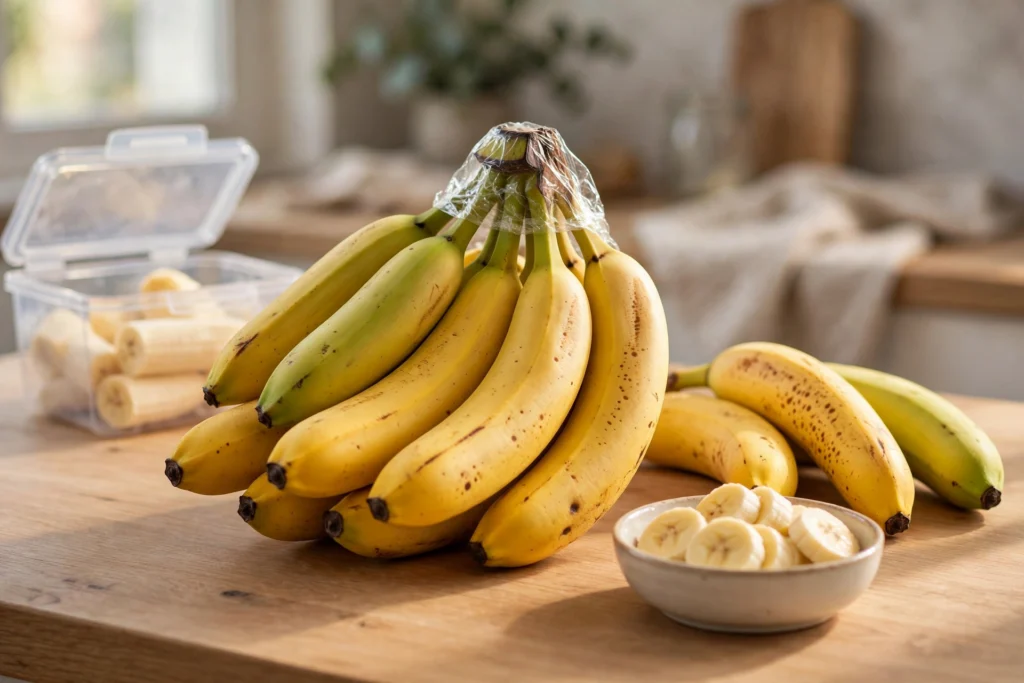
The idea is simple: cover the top ends of the bananas with a small piece of plastic wrap.
You do not need to wrap the entire banana. The stem area is the part you’re trying to cover.
I usually separate the bananas first and then wrap the stem of each individual banana. You can also leave the bunch together and wrap the top of the bunch.
Does it make bananas last forever? Definitely not.
But I find it useful when I have bought more bananas than I can eat immediately.
The important thing is to keep expectations realistic. Stem wrapping is a way of potentially slowing ripening, not stopping it completely.
If you are trying this method, use a small amount of wrap and make sure the fruit remains dry and clean. There is no need to tightly wrap the whole banana.
For me, this works best as part of a larger storage routine rather than as a miracle solution.
Should You Separate Bananas or Keep the Bunch Together?
This is another question that comes up whenever I buy bananas.
Should I leave them together or separate them?
Personally, I separate them when I know I am going to eat them at different times.
The advantage is convenience. Once the bananas are separated, I can use the ripest one first and leave the firmer ones for later.
I also find that separating them makes it easier to wrap individual stems and keep track of which banana needs eating next.
On the other hand, if I know the whole bunch will be eaten within a few days, I don’t bother.
There is no reason to turn banana storage into a complicated kitchen project.
The most useful approach is to think about your eating habits.
If everyone in your home eats bananas quickly, leave the bunch together and enjoy them.
If you regularly end up throwing away the last two or three bananas because they become too soft, separating them and managing them individually can be worthwhile.
I have found that the best storage method is usually the one that matches how quickly you actually eat the fruit.
Do Bananas Stay Fresh Longer in the Fridge?
Yes, refrigeration can help extend the useful life of ripe bananas, but there is an important catch.
The peel may turn dark brown or even look almost black in the refrigerator. That can make the banana look much worse than it actually is.
The inside can still be perfectly good.
I usually move bananas into the refrigerator once they have reached the level of ripeness I want. The cold temperature slows the ripening process, giving me extra time to use them.
This is particularly useful when the bananas have become yellow and I know I won’t finish them in the next day or two.
However, I don’t normally put very green bananas in the refrigerator when I want them to ripen naturally. If I want them to become sweeter and softer, I leave them at room temperature first.
So my basic routine is:
- Keep green or partly green bananas on the counter.
- Let them reach the ripeness I prefer.
- Move ripe bananas to the refrigerator if I need more time.
- Don’t worry too much about a darkened peel.
- Check the actual fruit inside before deciding whether it is still good.
Refrigeration can moderately extend the shelf life of fresh fruit by slowing ripening processes, according to University of Minnesota Extension guidance.
The refrigerator isn’t a way to make bananas stay yellow forever. It is more like a pause button that helps you get extra usable time once the bananas are ripe.
My Favorite Trick: Buy Bananas at Different Stages
One of the simplest changes I made was to stop buying every banana at exactly the same ripeness.
If I buy a bunch that is completely yellow, I know they are all going to become ripe around the same time.
Instead, I sometimes choose bananas with slightly different levels of ripeness.
That way, I can eat the yellow ones first while the greener ones catch up.
It sounds obvious, but it has made a bigger difference for me than constantly trying new storage gadgets.
If you’re shopping for a family, you can also buy a smaller bunch more frequently instead of buying a large bunch once a week.
Sometimes the best food-storage trick is simply buying an amount that matches your household.
How to Freeze Bananas for Later
When bananas have gone beyond the stage where I want to eat them fresh, I don’t automatically throw them away.
I freeze them.
This is probably my favorite way to rescue bananas that are getting too ripe.
First, I peel the bananas. Then I cut them into chunks.
I place the pieces in a freezer-safe container or bag. If I have time, I spread the pieces out on a tray first and freeze them individually. Once they are frozen, I transfer them into a container or freezer bag.
This makes it easier to take out only the amount I need.
Frozen banana pieces are particularly handy for smoothies, baking, and other recipes where the soft texture isn’t a problem.
I wouldn’t freeze a banana and expect it to come back with exactly the same texture as a fresh banana. Freezing changes the texture, so thawed banana is generally much softer.
But for cooking and blending, that doesn’t bother me at all.
University of Minnesota Extension recommends freezing fruit at peak quality and notes that freezing can significantly extend its storage life. For best quality, properly frozen fruit is generally recommended for use within about 8 to 12 months.
I personally try to use my frozen bananas much sooner than that because I prefer their flavor and texture when they haven’t been sitting in the freezer forever.
Don’t Throw Away Bananas Just Because the Peel Is Brown
This is probably the biggest lesson I’ve learned.
A brown banana isn’t automatically a bad banana.
The peel can become heavily spotted while the inside is still perfectly usable.
In fact, very ripe bananas can be excellent for baking because they are soft and naturally sweet.
When my bananas reach that stage, I usually stop thinking about eating them like a snack and start thinking about what I can make with them.
Banana bread is the obvious choice, but ripe bananas can also work well in smoothies, pancakes, muffins, oatmeal, and other recipes.
Of course, if the banana has mold, an unusual smell, leaking liquid, or other obvious signs of spoilage, I don’t try to save it.
But a dark peel alone isn’t enough for me to throw it away.
A Simple Banana Storage Routine That Works for Me
If you want to keep things simple, you don’t need a complicated system.
This is the routine I use:
When bananas are green:
I leave them at room temperature and away from heat and direct sunlight.
When they become yellow:
I eat the ripe ones first and keep an eye on the rest.
When I need extra time:
I move ripe bananas into the refrigerator.
When they become very ripe:
I either use them in baking or peel, cut, and freeze them.
When buying bananas:
I try not to buy a huge bunch unless I know we’ll eat them quickly.
That routine covers most situations without requiring special equipment.
And if you’re interested in how the body handles nutrients at the cellular level, you can also read this guide to secondary active transport on GameVerseHub.
Conclusion
Learning how to keep bananas fresh longer doesn’t require anything fancy.
For me, the biggest difference comes from controlling temperature, avoiding unnecessary heat, separating bananas when useful, wrapping the stems if I need extra time, and moving ripe bananas into the refrigerator.
And when all else fails, the freezer is there.
The most important thing is to work with the natural ripening process rather than trying to completely stop it. Bananas are going to ripen. The trick is simply slowing them down enough to fit your eating schedule.
I also think it’s worth remembering that a few brown spots aren’t a failure. Sometimes they are just a sign that your banana has reached the perfect stage for a smoothie, muffin, or loaf of banana bread.
Once I stopped expecting every banana to stay bright yellow for a week, storing them became much easier.
Frequently Asked Questions
1. Do bananas stay fresh longer in the fridge?
Yes. Refrigeration slows the ripening process and can give ripe bananas more usable time. The peel may turn dark, but the inside can remain perfectly good.
2. Should I wrap banana stems?
You can wrap the stems with a small amount of plastic wrap to potentially slow ripening. I find it most useful when combined with good storage conditions.
3. Is it better to separate bananas?
Separating them can be useful if you want to eat them at different times. It also makes it easier to wrap individual stems and manage each banana separately.
4. Can I freeze ripe bananas?
Absolutely. Peel and slice them before freezing, preferably in portions you can easily use later. Frozen bananas are especially useful for smoothies and baking.
5. Why do bananas turn brown so quickly?
Bananas naturally continue ripening after they are harvested. Ethylene and other ripening processes cause changes in color, texture, sweetness, and aroma as the fruit matures.