Secondary Active Transport: Definition, Types, Process & Examples

Secondary active transport is a membrane transport process that uses the energy stored in an ion gradient to move another substance against its gradient. Unlike primary active transport, the transporter itself does not directly use ATP.
Table of Contents
This process helps explain how cells take up nutrients and control their internal conditions. A familiar example is sodium helping glucose enter cells in the small intestine. Sodium moves in a favourable direction, and the transporter links that movement to glucose uptake.
The key is to follow the energy. In many animal cells, an ATP-powered pump maintains the sodium gradient. A separate transport protein then uses that gradient to move another substance. This indirect energy supply is what makes the process “secondary.” OpenStax’s explanation of active transport introduces this distinction.
What Does Secondary Active Transport Mean?
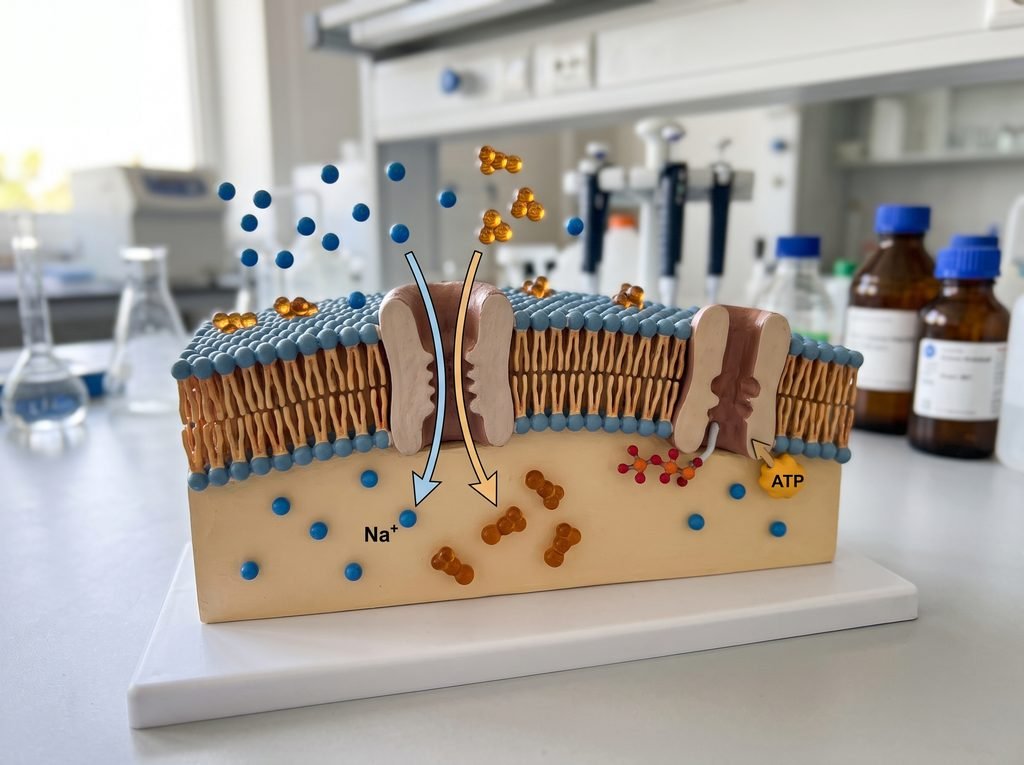
The name describes both the job and its energy source. “Transport” means moving material across a membrane. “Active” means the process can drive a substance against its concentration or electrochemical gradient. “Secondary” means the transporter draws on a gradient rather than directly using ATP to power its transport cycle.
A solute is a substance dissolved in a liquid. Glucose and sodium ions are examples. A gradient is a difference across space, such as a higher concentration of sodium outside a cell than inside it.
For an uncharged substance, moving from a lower concentration to a higher one is uphill movement. For an ion, which carries an electrical charge, the voltage across the membrane also matters.
The crucial feature is coupling: the transport protein connects a favourable movement with an otherwise unfavourable one. Two substances merely crossing the membrane at the same time would not be enough. Their movement must be linked through the transport mechanism. PhysiologyWeb’s membrane transport lesson explains this relationship.
An Analogy for Understanding the Energy
Imagine a falling weight connected to a small lift by a rope. As the weight moves down, it can pull the lift up. The upward movement becomes possible because it is connected to another movement that releases energy.
In this analogy, the falling weight represents the driving ion. The lift represents the substance moving uphill. The connecting mechanism represents the transporter.
This is a teaching analogy, not a literal picture of the protein. Molecules do not carry tiny ropes, and ions do not physically tow glucose through the membrane. The analogy simply shows why the two movements must be connected.
Understanding the Electrochemical Gradient
An electrochemical gradient combines two influences: a concentration difference and an electrical difference.
The concentration part depends on how much of an ion is present on each side of the membrane. The electrical part depends on the membrane voltage and the ion’s charge.
For example, a positively charged ion may have both a concentration gradient and an electrical attraction encouraging it to enter a cell. In other circumstances, those influences may oppose each other. This is why “high to low concentration” is an incomplete rule for predicting ion movement.
For uncharged glucose, voltage does not act directly on the molecule in the same way. For sodium, written Na+, both influences must be considered. The discussion of ion movement in The Cell: A Molecular Approach explains the importance of charge as well as concentration.
When reading a diagram, ask two separate questions: where is the ion more concentrated, and which side attracts its charge? You do not need an equation to recognise that both can affect the answer.
How Secondary Active Transport Works Step by Step
Consider a simplified example in which sodium drives glucose into an animal cell.
A Pump Maintains the Sodium Difference
The sodium-potassium pump uses ATP to move sodium out of the cell and potassium into it. In its usual cycle, it exports three sodium ions and imports two potassium ions.
This is primary active transport because the pump uses ATP directly. Its activity helps keep intracellular sodium low. Molecular Biology of the Cell’s chapter on membrane transport describes how this pump supports sodium-driven transport.
A Separate Carrier Couples Sodium and Glucose Movement
A sodium-glucose transporter provides binding sites for the substances it carries. It changes shape during its transport cycle, exposing those sites to different sides of the membrane.
Sodium’s favourable inward movement can support glucose entry even when glucose must move uphill. Research on the structure and mechanism of SGLT transporters shows how these proteins support sodium-linked sugar transport.
The Gradient Must Be Maintained
Every transport cycle uses some of the stored driving force. Continuing sodium entry would gradually weaken the gradient if sodium were not removed again.
The pump and carrier therefore belong to a connected system. One maintains a source of usable energy; the other draws on it.
For revision, sketch the two proteins separately. Put “ATP” beside the pump and “sodium plus glucose” beside the cotransporter. This prevents the common mistake of placing ATP directly on the glucose carrier.
Symport and Antiport: The Two Main Arrangements
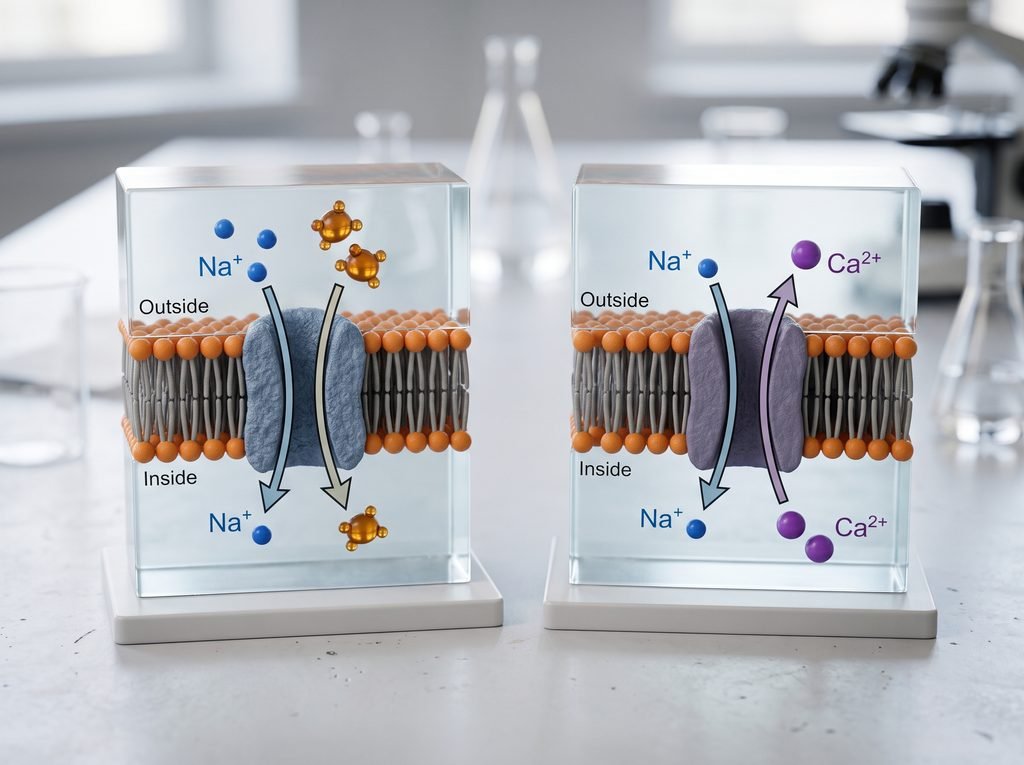
The words symport and antiport describe the directions in which transported substances cross the membrane.
Symport Moves Substances in the Same Direction
A symporter carries different substances in the same direction across a membrane. Sodium and glucose entering a cell together are a standard example.
“Same direction” does not mean “same relationship to the gradient.” Sodium can move downhill while glucose moves uphill, even though both enter the cell.
To read a symport diagram, look first at the arrows. If both point from outside to inside, their physical directions match. Then examine each substance’s gradient separately.
Antiport Moves Substances in Opposite Directions
An antiporter exchanges substances across a membrane in opposite directions. One enters while the other leaves.
For instance, inward sodium movement can support outward calcium movement. The exchange is linked, even though the arrows point different ways.
Direction and energy source are separate classifications. Seeing opposite arrows does not, by itself, prove that a protein performs secondary active transport. You still need to identify what powers it. These directional categories are outlined in OpenStax’s section on carrier proteins.
| Feature | Symport | Antiport |
|---|---|---|
| Relative movement | Same direction | Opposite directions |
| Typical diagram | Both arrows enter or both leave | One arrow enters and one leaves |
| Example | Sodium-glucose cotransport | Sodium-calcium exchange |
| Question about energy | Which gradient drives the coupled movement? | Which gradient drives the coupled movement? |
5 Examples of Secondary Active Transport
The following examples show how the same broad principle supports different functions. The first two involve glucose, but they solve different problems in different organs.
| Example | Transporter | Type |
|---|---|---|
| Intestinal glucose uptake | SGLT1 | Symport |
| Kidney glucose reabsorption | SGLT | Symport |
| Sodium-calcium exchange | NCX | Antiport |
| Sodium-hydrogen exchange | NHE | Antiport |
1. Glucose Absorption in the Small Intestine
After carbohydrate digestion, glucose must cross the intestinal lining to reach the body’s circulation.
SGLT1, a sodium-glucose cotransporter, helps glucose enter intestinal cells from the gut lumen. The lumen is the space inside the intestine. SGLT1 normally couples two sodium ions to one glucose molecule, with both moving into the cell.
This is symport. Its value is that glucose uptake can continue under conditions where simple downhill glucose movement would not be enough. The role and coupling ratio of SGLT1 are described in the original SGLT structural study.
2. Glucose Recovery in the Kidneys
The kidneys filter small substances, including glucose, from the blood into fluid within kidney tubules. Useful filtered glucose must then be recovered.
Sodium-glucose transporters support its movement into cells lining the proximal tubule. This is called reabsorption because the glucose is being returned toward the blood after filtration.
Compare the jobs: the intestine absorbs glucose from food, while the kidney recovers filtered glucose. Both use sodium-linked transport. The same SGLT research paper identifies these intestinal and renal roles.
3. Uptake of Certain Amino Acids
Amino acids are the building blocks used to make proteins. Some transport systems in intestinal and kidney cells couple amino acid uptake to sodium movement.
These carriers have different substrate preferences. There is no single sodium carrier that transports every amino acid in every tissue.
The useful lesson is broader than one nutrient: an ion gradient can support the uptake of several kinds of substance through different transport proteins. Molecular Biology of the Cell describes sodium-driven systems for sugars and amino acids.
4. Sodium-Calcium Exchange
Cells need to control calcium in their cytoplasm, the internal fluid surrounding many cell structures.
In its usual calcium-exporting mode, the sodium-calcium exchanger moves three sodium ions inward for one calcium ion moved outward. This is antiport.
The sodium gradient supplies energy for calcium removal. The exchanger differs from an ATP-powered calcium pump, even though both can help move calcium out of the cytoplasm. StatPearls’ active transport overview explains the exchange ratio and energy relationship.
5. Sodium-Hydrogen Exchange
The sodium-hydrogen exchanger links sodium entry to hydrogen ion removal. Hydrogen ions, written H+, are closely connected with acidity.
This exchange can help cells regulate internal pH. It is another antiport example: sodium and hydrogen move in opposite directions.
Here, the biological goal is not nutrient absorption. It is control of the cell’s internal chemical conditions. The Cell’s explanation of sodium-hydrogen exchange describes this role in pH regulation.
Primary Active Transport vs Secondary Active Transport
To distinguish these mechanisms, identify the immediate energy source.
An ATP-driven pump directly couples ATP breakdown to transport. A secondary transporter couples transport to another substance’s downhill movement.
Facilitated diffusion also involves membrane proteins, but the transported substance moves down its own gradient without an uphill cargo coupled to it.
| Process | Immediate driving force | Can drive uphill transport? | Example |
|---|---|---|---|
| Primary active transport, ATP-driven example | ATP breakdown | Yes | Sodium-potassium pump |
| Secondary active transport | Another substance moving downhill | Yes | Sodium-glucose cotransporter |
| Facilitated diffusion | The transported substance’s own gradient | No | Glucose movement through a GLUT carrier |
These distinctions concern individual transport steps. A whole biological pathway may include several different kinds of movement.
For example, intestinal glucose can enter a cell through sodium-linked transport and leave across the other side through a GLUT carrier by facilitated diffusion. The sodium-potassium pump maintains the gradient supporting uptake. The Cell’s account of intestinal glucose transport illustrates this division of work.
When a question asks, “Is glucose transport active or passive?”, check which membrane protein and which step it describes. “Glucose” alone does not determine the answer.
What Limits the Process?
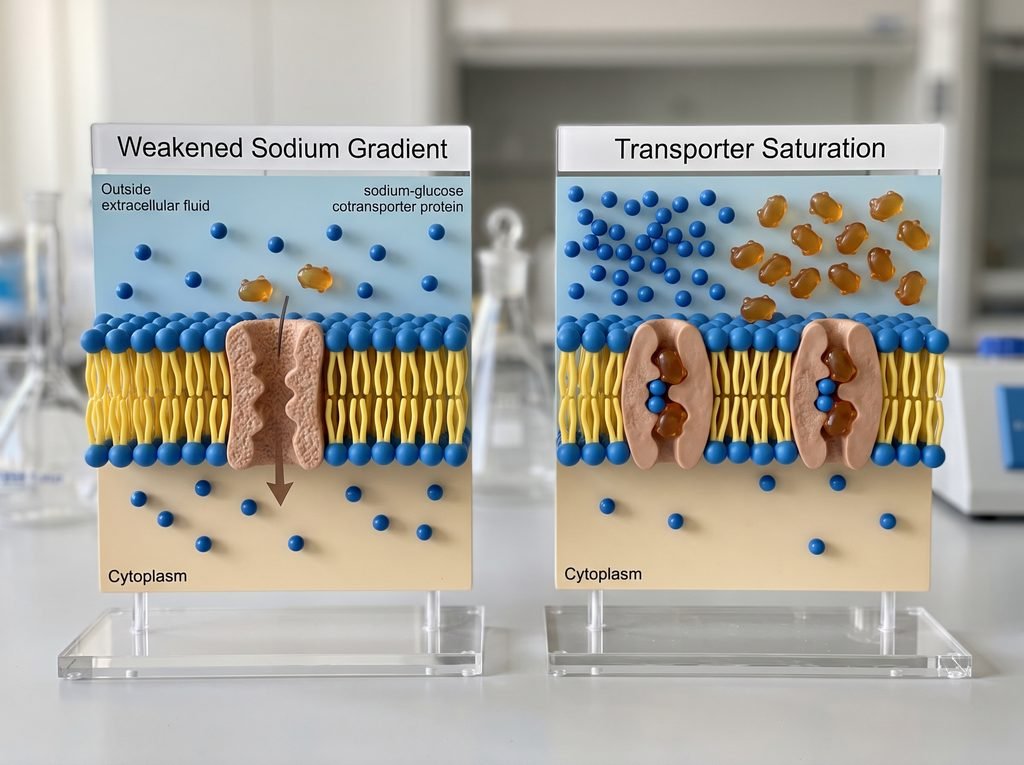
Secondary active transport depends on the conditions around the carrier. The presence of a transport protein does not guarantee unlimited movement.
A Weak Gradient Provides Less Driving Force
The driving gradient must supply enough energy for the coupled transport cycle. If conditions change, uphill transport may become less favourable.
For an ion-driven process, changes in concentration or membrane voltage can matter. Some coupled carriers can also reverse direction under suitable conditions. A diagram’s arrow therefore describes a particular situation, rather than an unchangeable rule for every transporter. Molecular Biology of the Cell discusses how transport depends on the driving gradient.
Transport Proteins Have Limited Capacity
A membrane contains a finite number of carriers, and each takes time to complete its cycle. Adding more cargo cannot make a fixed group of carriers work infinitely fast.
This helps explain saturation: after a point, more available substrate produces a smaller increase in transport rate.
A useful analogy is a building with a fixed number of revolving doors. More people arriving can fill the available capacity, but they cannot make every doorway process an unlimited crowd. This analogy concerns capacity only; it does not represent the energy mechanism.
Blocking ATP Production Has Indirect Effects
In a cell that relies on an ATP-driven pump to maintain the gradient, reducing ATP supply can eventually reduce secondary transport.
However, the stored gradient does not necessarily disappear the instant ATP production falls. Existing gradients may support some movement for a time.
This distinction matters in experiments: “does not use ATP directly” and “cannot be affected by ATP depletion” mean different things. StatPearls’ overview of active transport describes the connection between pumps, gradients, and coupled transport.
Common Mistakes and How to Avoid Them
One mistake is calling secondary transport passive because ATP is absent from the transporter’s diagram. Always look for the uphill substance and the source of energy supporting it.
Another is assuming symport means both substances move down their gradients. Symport tells you that the arrows point in the same direction. It does not tell you whether each movement is uphill or downhill.
A third mistake is describing sodium as attaching to glucose and dragging it through the membrane. A clearer explanation is that the protein binds the transported substances and couples their movement through its transport cycle.
Students also sometimes label the sodium-potassium pump as secondary transport because it moves two ion types. Counting substances is not the test. The energy source is.
Finally, avoid treating every glucose carrier as an active transporter. Name the carrier whenever possible. “Sodium-glucose cotransporter” tells the reader much more than “glucose protein.”
How to Identify the Mechanism in a Biology Question
Start by reading the labels before looking at the arrows. Identify the inside and outside of the cell, the substances involved, and any ATP symbol.
Next, trace each substance separately. Does it enter or leave? Does the question provide concentrations, electrical conditions, or a statement that it moves against its gradient?
Then ask how the movements are connected. A downhill ion movement that powers uphill transport through a coupled carrier indicates secondary active transport. Matching arrows indicate symport; opposite arrows indicate antiport.
Consider this hypothetical practice scenario: a diagram shows sodium and an uncharged nutrient entering through one carrier. Sodium moves down its electrochemical gradient, while the nutrient enters a region where its concentration is already higher.
The answer is secondary active symport. “Secondary active” identifies the energy arrangement; “symport” identifies the shared direction.
Now change only the nutrient’s arrow so it leaves while sodium enters. If sodium still powers uphill nutrient movement, the arrangement is secondary active antiport.
When writing an explanation, use three parts: name the driving substance, state that it moves down its gradient, and explain that its movement powers the uphill transport of another substance.
Frequently Asked Questions
Does “Secondary” Mean Slower or Less Important?
No. The word describes the indirect energy relationship. It does not rank the process by speed or importance.
Is Sodium the Only Possible Driving Ion?
No. Hydrogen ion gradients also drive many coupled transport systems, including systems in bacteria and yeast. Sodium-driven examples are especially useful when learning about animal cell membranes. Molecular Biology of the Cell describes both sodium-driven and proton-driven carriers.
Is Cotransport Always Another Word for Symport?
Terminology varies. Some teaching materials use cotransport mainly for same-direction movement. Others use it more broadly for coupled transport. Use “symport” or “antiport” when direction needs to be unambiguous.
Can the Same Substance Move by Different Mechanisms?
Yes. The mechanism depends on the transport protein and conditions. Glucose provides a useful example because sodium-linked uptake and GLUT-mediated facilitated diffusion can occur at different steps in its movement through a tissue.
Conclusion
Secondary active transport uses energy stored in an ion gradient to power the uphill movement of another substance. Symport carries substances in the same direction; antiport moves them in opposite directions.
The most useful study habit is to follow the energy before naming the mechanism. Ask what moves downhill, what moves uphill, and how their movements are linked.
Try drawing the intestinal glucose example from memory. Label the ATP-driven pump, sodium gradient, sodium-glucose carrier, and glucose exit route. Then explain each step in one sentence. If you can connect those steps clearly, you have understood the central idea.