backtofrontshow in 2026: What It Is, Pricing, and What to Know
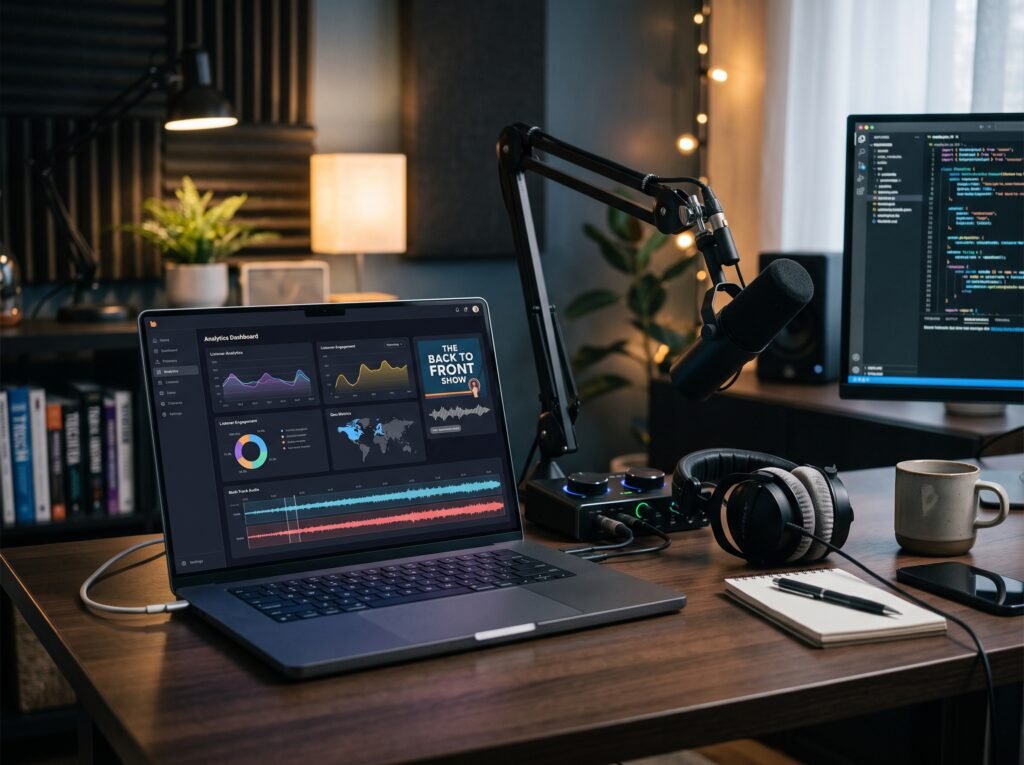
When I started looking into backtofrontshow, the first thing that caught my attention was how differently the name is used across the internet. Some pages point to an older web-development podcast, while the website currently using the name presents itself as a podcast analytics platform with expensive monthly plans.
Table of Contents
That difference matters. Someone searching for a podcast to listen to could easily misunderstand information intended for a business considering analytics software. On the other hand, a podcast creator researching software needs more than an attractive homepage and a list of features to make a sensible decision.
I looked at the available website pages, the archived episode information, and the published pricing details to understand what could actually be confirmed. There are useful details to discuss, but there are also unanswered questions.
Here is what I found about backtofrontshow, how its different identities fit together, what the published prices mean, and what I would check before spending money on anything connected with the name.
What Is BacktoFrontShow?
BacktoFrontShow is a name associated with two different online identities.
The first is an older web-focused podcast. Its archived Episode #001 page identifies Keir Whitaker and Kieran Masterton as the hosts and describes the programme as an almost-weekly podcast covering back-end technology, front-end development, and related subjects. The episode notes include conversations about working collaboratively, website-generation tools, web-design events, and technology.
The second identity is the current website at BacktoFrontShow.com, which describes itself as a podcast analytics platform. Rather than presenting itself primarily as a listening destination, the website promotes tools for understanding podcast audiences and measuring engagement.
According to its homepage, the platform is designed to help podcasters and media teams examine listener demographics, listening behaviour, device preferences, geographical patterns, and audience engagement. It also advertises reporting features intended to help users understand how their episodes perform.
These are the features the website claims to offer, not results I could independently verify through customer testing.
The distinction becomes particularly important when looking at prices. The analytics website publishes monthly subscription figures, but those figures should not automatically be interpreted as the cost of listening to the older podcast.
The relationship between the archived show and the current software website is not clearly explained in the pages I reviewed. I would therefore treat them as separate identities unless the operator provides reliable documentation showing otherwise.
How It Started: The Story Behind the Show
The older Back to Front Show had a straightforward subject: the everyday world of web design and development.
Its archived first-episode page describes a programme hosted by Keir Whitaker and Kieran Masterton. The conversations were not limited to writing code. They also touched on professional life, working arrangements, emerging website technologies, creative projects, and the wider culture surrounding the web industry.
That broader approach is part of what made the concept interesting. Web development is not simply a matter of choosing a programming language or getting a website to work. People working in the field also deal with clients, deadlines, changing tools, collaboration, and decisions about how to build and maintain digital products.
The original episode notes reflect that mixture of technical and everyday discussion. Topics include the advantages and disadvantages of coworking, flat-file website generation, an upcoming web-design conference, and equipment used to record the show.
I find that detail more useful than vague descriptions promising to revolutionise podcasting. It tells us what the archived programme actually discussed.
However, the history of the current analytics platform is less clear from the public pages reviewed. The website advertises a software service, but I could not establish a documented launch history explaining when that service began or how it relates to the original podcast.
There is a difference between finding an old episode page and establishing the history of a present-day business. One is evidence of archived content; the other requires clear information about the product, its operator, and its development.
Until that connection is explained, I would avoid presenting a single, uninterrupted story that treats the old podcast and the current analytics service as unquestionably the same project.
How the Format Actually Works
To understand backtofrontshow, it helps to separate the podcast format from the software workflow.
The archived podcast was conversation-based. Its first episode brought together several topics around web development and professional life rather than following a fictional storyline or a scripted entertainment format.
For somebody interested in the history of web design, that style can be appealing. Conversations often preserve the questions, preferences, and practical concerns that people in an industry were discussing at the time. An older episode can therefore offer a different perspective from a modern tutorial explaining the latest tools.
The current analytics website describes a different kind of experience. Its published workflow has four broad stages.
First, the user connects a podcast to the platform. The website describes this as the integration stage, although the public explanation does not provide enough technical detail to establish which hosting providers, podcast feeds, or external services are supported.
Second, the platform says it collects information about listening behaviour. Third, users can review the resulting information through an analytics dashboard. Finally, the website advertises custom reports that allow teams to organise their findings around particular needs.
The advertised features include audience demographics, episode performance, engagement measurements, geographical information, and device analytics. More advanced features are also mentioned on its pricing pages.
That workflow makes sense as a general description of analytics software, but the important questions concern the details: where the data comes from, how much is collected, how accurate it is, and what a customer can actually access.
A dashboard can make information easier to read, but its value depends on the quality of the underlying information. Before making a purchase, I would want clear answers about those details rather than relying entirely on a feature list.
The Pricing Myth, Debunked
The confusion surrounding backtofrontshow pricing needs a careful explanation.
Some people searching the keyword may be looking for the cost of accessing the older podcast. Others may have encountered the current website’s analytics plans and assumed those prices apply to everything associated with the name.
They do not necessarily refer to the same thing.
The current BacktoFrontShow pricing page displays three plans: Basic, Pro, and Enterprise. The first two have published monthly figures, while the Enterprise plan requires prospective customers to contact the provider.
That means it would be inaccurate to say that the current website publishes no prices at all. It does.
The real issue is what those prices represent and whether the advertised service can justify them for a particular customer. A price displayed on a website is evidence of the advertised offer, but it does not independently establish product quality, customer satisfaction, data accuracy, or business legitimacy.
There is another important distinction. The archived podcast episode is publicly accessible, and the episode page does not list a listener subscription fee. The current software prices should not be presented as a charge to listen to that archived episode.
My conclusion is simple: the pricing figures are not imaginary simply because they seem high. They are published prices for the analytics product. What remains uncertain is the level of service a customer will receive, the applicable contract terms, and the documented connection between the software site and the older podcast.
Those questions deserve answers before anyone treats the displayed prices as a complete picture.
What It Actually Costs to Get Involved
The current website publishes the following pricing structure.
| Plan | Published price | Advertised position |
|---|---|---|
| Basic | $1,200 per month | Audience information, episode performance, listening trends, and reports |
| Pro | $3,600 per month | Basic features plus additional analytics and integration-related capabilities |
| Enterprise | Custom pricing | Expanded reporting, customisation, and additional business-oriented features |
These prices reflect the figures displayed on the website when I checked it on October 9, 2026. They should be reconfirmed directly before making a purchasing decision.
The amounts also add up quickly. If the published monthly rates remained unchanged for 12 months, the Basic plan would total $14,400 and the Pro plan would total $43,200. Those are simple calculations, not advertised annual packages or confirmed contract prices.
The Enterprise plan cannot be calculated because a price is not publicly specified.
There is another detail worth paying attention to: the website includes language inviting visitors to request access or start a free trial. However, the pages I reviewed did not clearly establish the trial duration, whether payment information is required, which features are available during the trial, or what happens when a trial ends.
I would confirm all of those terms in writing.
The same applies to cancellation rules, automatic renewals, currency, usage limits, and any extra charges. A customer should know the complete expected cost rather than focusing solely on the monthly figure.
For someone looking only for archived podcast episodes, I found no listener-access price on the old episode page. For a business considering the current analytics product, however, the published monthly amounts represent a substantial commitment.
These are two very different financial decisions, and they should be evaluated separately.
Why Everyone Is Talking About It Right Now
I would be careful with the claim that everyone is talking about backtofrontshow.
I could not verify a particular viral event, major product announcement, or official launch that establishes why the name is supposedly trending in 2026. Search interest and a growing number of articles do not, by themselves, prove widespread popularity.
What is clear is that the name can lead searchers toward conflicting information.
One result may describe the older technology podcast. Another may present podcast analytics software. Other articles may focus almost entirely on the monthly prices. When those descriptions are read without checking their original sources, it becomes easy to confuse an archived entertainment or educational programme with a commercial product.
The unusually high published prices may also attract attention because readers naturally want to understand what a service provides when it costs thousands of dollars each month. That is a plausible explanation for curiosity, but it is not proof of a particular trend.
The lack of a clear public explanation connecting the two identities adds another layer of uncertainty.
For me, the useful question is not whether backtofrontshow is receiving attention. It is whether the information attracting that attention is reliable and relevant to the person searching.
If a particular article claims that the service has recently become popular, introduced a new plan, or attracted a large customer base, I would look for a dated announcement or another credible source supporting that statement. Without that evidence, I would not repeat the claim as established fact.
Is BacktoFrontShow Worth Your Time and Money?
My answer depends on what you are trying to find.
If you want to explore the older web-development podcast, the archived episode page offers a starting point. Its subject matter may be interesting to people curious about how developers discussed tools, working practices, and the web industry. You do not need to assume that the modern analytics prices apply to listening to that material.
If you run a podcast and are evaluating analytics software, the decision is more complicated.
Audience information can be valuable when it answers real questions. For example, a creator might want to understand which episodes keep listeners engaged, which topics attract an audience, or how performance changes over time. Useful measurements can inform decisions about future content.
However, analytics are only valuable when the information is sufficiently reliable and the insights justify the expense. A beautifully presented dashboard is not enough by itself.
At the published Basic price of $1,200 per month, I would expect detailed documentation, a clear explanation of the available data, a demonstration using relevant examples, and transparent contract terms. At $3,600 per month, the case for paying should be even stronger.
I would also compare the offer with information already available through my hosting provider and podcast platforms. Apple’s official guide to listener analytics in Apple Podcasts explains the kinds of performance measurements available to creators through its own tools.
I cannot confirm that BacktoFrontShow is worth its listed prices because the public information I reviewed does not establish enough about its actual performance or customer outcomes. That is not proof that the product has no value; it means there is not enough independently verified information to recommend it confidently.
Tips If You’re Planning to Try It
Before interacting with anything connected to backtofrontshow, I would start by establishing exactly which product or archive I was looking at.
First, identify the intended service. Decide whether you are trying to listen to the old podcast or evaluate the current analytics platform. Do not assume that the two share the same ownership, commercial terms, or purpose simply because they use the same name.
Second, request a proper demonstration. If the analytics software interests you, ask to see the dashboard and sample reports. Find out what information is measured, how it is collected, how frequently it is updated, and which podcast platforms or hosting services it supports.
Third, ask about data quality and privacy. Demographic and behavioural information can be useful, but the provider should explain what the figures represent and what limitations apply. Ask how your account and podcast data will be handled, who can access it, and whether the service needs permission to connect to other accounts.
Fourth, confirm the full financial commitment. Request the total price, currency, payment schedule, trial conditions, cancellation process, renewal terms, and any extra charges in writing. Do not interpret a trial button as proof that a free trial is available without conditions.
Finally, take time to verify the provider. Look for consistent contact information, clear business details, usable documentation, and references that you can independently check. Be cautious about claims that cannot be demonstrated, especially when the service requires a large upfront commitment or access to sensitive account information.
None of these checks proves that a service is legitimate or illegitimate on its own. Together, however, they help you make a more informed decision instead of relying on a name, a price list, or polished marketing language.
Conclusion
BacktoFrontShow is more complicated than its name initially suggests. The online material includes an older web-development podcast archive as well as a current website promoting podcast analytics software.
The analytics website lists Basic at $1,200 per month, Pro at $3,600 per month, and custom pricing for Enterprise. Those are its published figures, but they do not establish whether the product will deliver enough value for a particular customer or fully explain the relationship with the older show.
I would not label the current service a scam based only on the information available, but I also would not treat the public material as sufficient proof of its legitimacy or performance.
If you are simply interested in the archived podcast, start with the original episode information. If you are considering buying the software, ask for a demonstration, verify the business and data practices, and get the complete commercial terms before paying.
The sensible approach is to separate what can be confirmed from what remains uncertain. That is especially important when the same name can lead you toward two very different experiences.
Frequently Asked Questions
What is BacktoFrontShow and why is it trending?
BacktoFrontShow is a name associated with an older web-development podcast and a current website advertising podcast analytics software. I could not verify a specific event that proves the name is broadly trending in 2026, and the two identities can make online search results confusing.
Is BacktoFrontShow really as expensive as people say?
The current website lists the Basic plan at $1,200 per month and the Pro plan at $3,600 per month, with custom pricing for Enterprise. Those figures describe the advertised analytics plans, not a confirmed charge for listening to the archived podcast.
How do I watch or follow BacktoFrontShow?
The older programme is a podcast, so its archived episode information is the most relevant starting point for listening. The current website presents an analytics service rather than a clearly documented new podcast series, so confirm which version you are looking for before signing up or paying.
Is BacktoFrontShow a scam or legit?
I could not establish enough independent evidence to confidently label the current analytics service either legitimate or fraudulent. Before paying, verify the operator, request a demonstration, and confirm the pricing, privacy, and cancellation terms in writing.
Is BacktoFrontShow worth it in 2026?
For someone interested in the older web-development podcast, the archived material may be worth exploring. For a business considering the analytics software, the published prices are substantial, and I would want clearer evidence of data quality, practical benefits, and customer value before committing.