New York Jets vs New England Patriots Match Player Stats: 2025
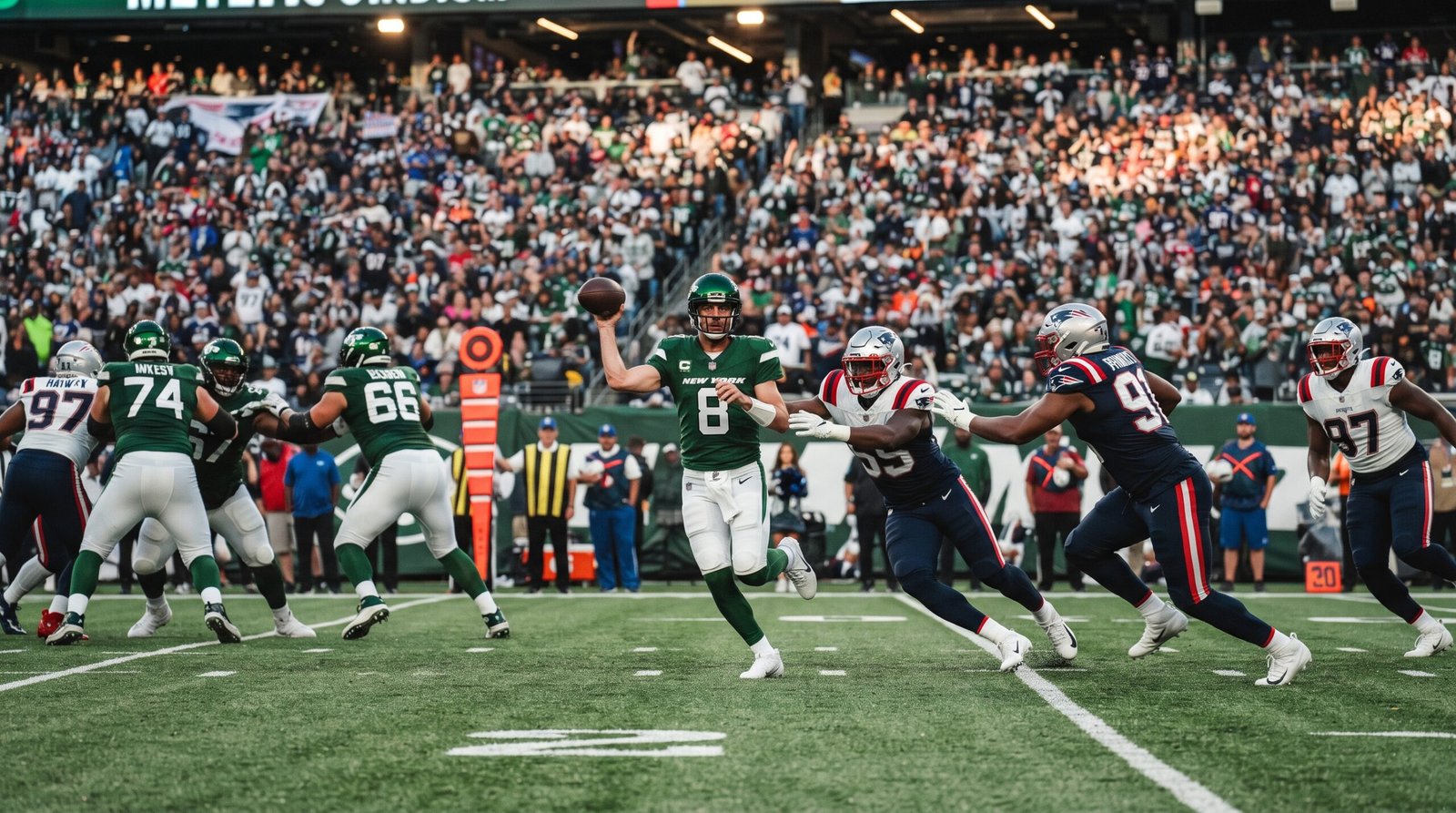
The new york jets vs new england patriots match player stats tell the story of a highly one-sided AFC East contest in the 2025 NFL regular season. When the New England Patriots traveled to MetLife Stadium on December 28, 2025, they produced one of their most convincing performances against the New York Jets, winning 42–10 after building a 35–3 advantage by halftime. The final score alone shows the difference between the two teams, but a closer look at the individual numbers explains exactly how the Patriots created such a large margin and why several Jets players struggled to influence the game.
Table of Contents
For fans searching for new york jets vs new england patriots match player stats, the most important starting point is the quarterback battle. New England quarterback Drake Maye completed 19 of 21 passes for 256 yards and five touchdowns without throwing an interception. His passer rating was an outstanding 157.0. The Jets, meanwhile, used Brady Cook for most of the game, and he completed 19 of 33 passes for 152 yards, no touchdowns and one interception. He finished with a 56.6 passer rating. Those passing numbers created a major statistical gap before the rushing and receiving figures are even considered.
The game also demonstrated an unusual combination of strong offensive efficiency from New England and a productive rushing performance from New York that never translated into a competitive result. The Jets rushed for 164 yards, compared with 155 for the Patriots, and Breece Hall alone produced 111 rushing yards on 14 carries. However, the Patriots were far more effective through the air, generating 285 net passing yards while New York managed only 143. New England also produced 28 first downs compared with 14 for the Jets and averaged 7.1 yards per offensive play compared with 4.9 for New York.
New York Jets vs New England Patriots Match Player Stats and What They Reveal
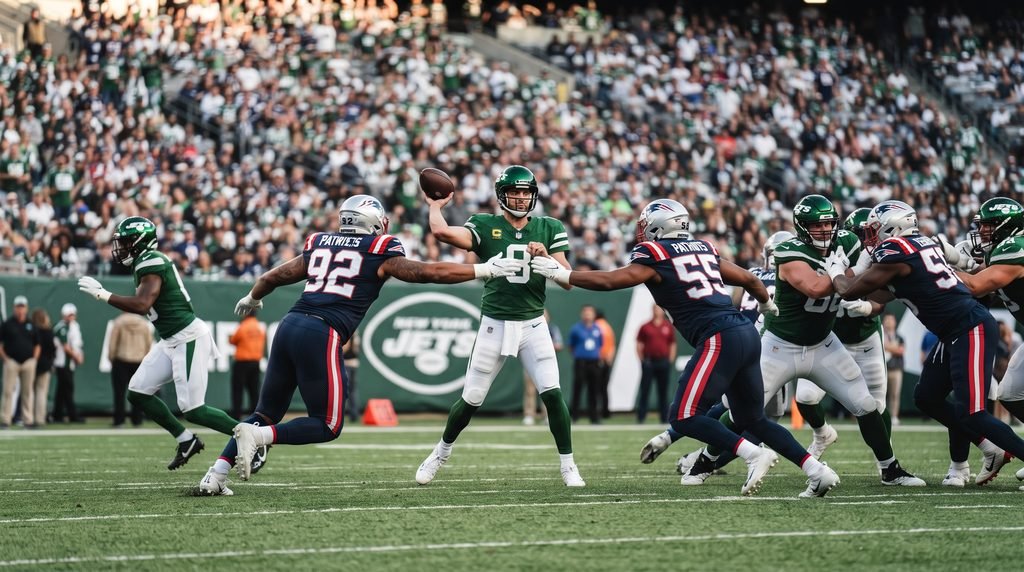
The new york jets vs new england patriots match player stats are especially useful because they show that this was not simply a game decided by one or two explosive plays. New England consistently won important statistical categories. The Patriots controlled the passing game, protected the football, finished drives with touchdowns and created a 42-point offensive total. New York did have moments of individual success, most notably Breece Hall’s 59-yard touchdown run, but the Jets could not sustain enough offense to remain within reach.
New England finished with 440 total yards on 62 offensive plays, while the Jets recorded 307 yards on 63 plays. The Patriots therefore gained considerably more yardage despite running one fewer offensive play. Their average of 7.1 yards per play was a major advantage over the Jets’ 4.9. New England also committed no turnovers, while New York turned the ball over once. The Patriots were penalized only twice for 20 yards, whereas the Jets committed five penalties for 53 yards.
The possession numbers were not dramatically different, with New England holding the ball for 31:55 and New York for 28:05. That makes the efficiency gap even more significant. The Patriots did not need overwhelming possession time to score repeatedly because their offense was consistently productive on individual drives. Their 4-for-9 third-down conversion rate and perfect 2-for-2 performance on fourth down helped sustain important possessions. The Jets converted only 5 of 16 third-down opportunities and 2 of 6 fourth downs.
Another revealing statistic in the new york jets vs new england patriots match player stats is the difference in net passing efficiency. New England posted 285 net passing yards and averaged 11.0 yards per pass play when sacks were included in the calculation. New York had only 143 net passing yards and averaged 4.1 yards per pass play. That difference explains why the Patriots could build such a large early lead while the Jets struggled to generate sustained scoring opportunities.
Drake Maye Leads the Patriots With a Remarkable Passing Performance
The biggest individual story in the new york jets vs new england patriots match player stats was undoubtedly Drake Maye. The Patriots quarterback delivered an almost flawless statistical performance, completing 19 of 21 attempts for 256 yards. His completion rate was approximately 90.5 percent, and he threw five touchdown passes without an interception.
Maye’s efficiency was even more impressive because his average completion produced significant yardage. He averaged 12.2 yards per completed pass attempt, according to the official game statistics. His longest completion went for 31 yards, and he finished with a passer rating of 157.0. The NFL game book lists only one sack for one yard against him.
Five touchdown passes in one game represent the type of production that can completely reshape a matchup. Maye connected with Austin Hooper, Rhamondre Stevenson, Stefon Diggs, Hunter Henry and Efton Chism for touchdowns. The distribution of those scores also showed that the Patriots were not relying on a single target. They were able to move the ball through several parts of their passing offense.
Maye was particularly effective early. New England scored twice in the first quarter, then added three touchdowns in the second quarter. By halftime, the Patriots had built a 35–3 lead, effectively deciding the contest before the second half began. Maye’s passing was central to that rapid start.
The new york jets vs new england patriots match player stats also show that Maye combined passing success with some value as a runner. He carried the ball three times for 22 yards, averaging 7.3 yards per attempt. That was not a huge part of the Patriots’ offensive plan, but it added another element for the Jets defense to account for.
Breece Hall Produces the Jets’ Best Individual Offensive Performance
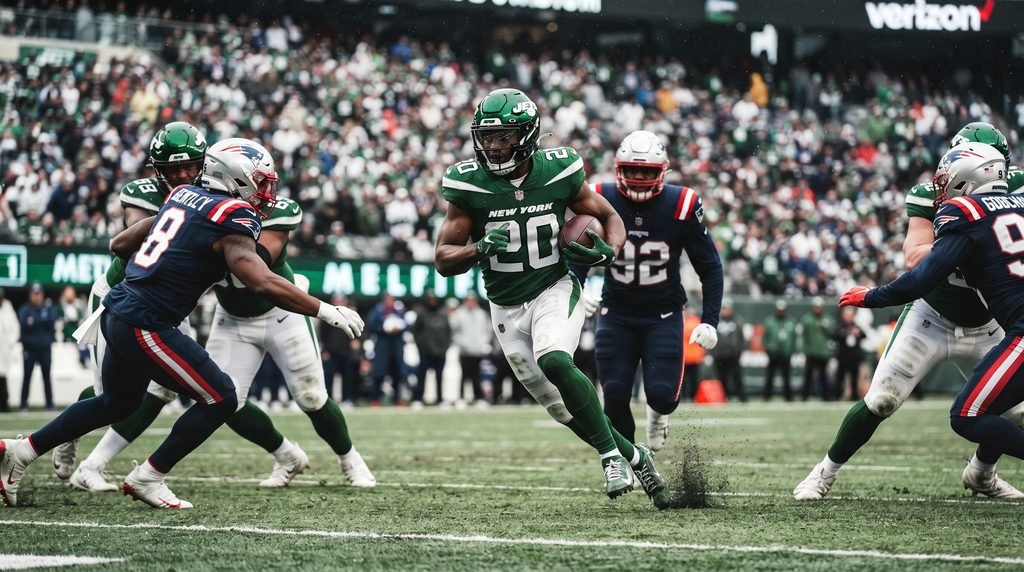
Although the Jets lost comfortably, Breece Hall emerged as the standout offensive player for New York. His 111 rushing yards on 14 carries gave him an impressive 7.9-yard average, and his 59-yard touchdown run produced the Jets’ only touchdown of the afternoon.
Hall’s long touchdown in the fourth quarter was particularly significant because it showed what the Jets running game was capable of producing when it found open space. The play covered 59 yards and immediately reduced the score from 42–3 to 42–10. It was the only Jets touchdown of the game, but it was also one of the biggest explosive plays of the afternoon.
The Jets collectively rushed for 164 yards on 28 carries, averaging 5.9 yards per rushing attempt. That was actually better than New England’s 155 rushing yards on 36 attempts, where the Patriots averaged 4.3 yards. This is one of the more interesting details in the new york jets vs new england patriots match player stats because it demonstrates that New York was not completely ineffective on the ground.
The problem was that the Jets could not pair their rushing success with consistent passing production. Their offense repeatedly stalled, especially on third and fourth downs. Hall’s individual numbers were strong, but his production did not translate into enough scoring possessions to challenge the Patriots.
Hall also caught two passes for 18 yards, giving him 129 total yards from scrimmage. That made him one of the Jets’ most productive all-around offensive players, even though the team’s overall passing attack remained limited.
Stefon Diggs Becomes New England’s Leading Receiver
Another major highlight in the new york jets vs new england patriots match player stats was the performance of Stefon Diggs. The veteran receiver caught all six of his targets for 101 yards and one touchdown. His average was 16.8 yards per reception, and his longest catch traveled 31 yards.
Diggs was one of several Patriots receivers who consistently created separation and converted Maye’s accurate throws into substantial gains. His six catches on six targets also illustrate the efficiency of the Patriots passing offense. New England did not waste many opportunities when it targeted key players.
His touchdown came on a three-yard reception in the second quarter and pushed the Patriots’ advantage to 28–3. By that point, New England had already established total control of the game.
Diggs’ 101 receiving yards gave him the only 100-yard receiving performance of the game. It also demonstrated how quickly New England could convert short and intermediate opportunities into productive drives. Although his touchdown catch itself covered only three yards, his longest gain was 31 yards, helping stretch the Jets defense vertically and horizontally.
Rhamondre Stevenson Contributes as a Runner and Receiver
Rhamondre Stevenson was another central piece of the Patriots offense in this matchup. He rushed eight times for 47 yards, averaging 5.9 yards per carry, with a long run of 24 yards and one rushing touchdown. He also caught all five of his targets for 55 yards and one receiving touchdown.
That gave Stevenson 102 total yards from scrimmage and two touchdowns. His combination of rushing and receiving production was especially valuable because it forced the Jets defense to defend him in multiple ways.
Stevenson scored New England’s second touchdown of the game on a one-yard run in the first quarter. Later, he caught a 22-yard touchdown pass from Maye on the final play of the first half. That second score was part of New England’s explosive sequence that created a 35–3 halftime lead.
The new york jets vs new england patriots match player stats therefore show that Stevenson was not simply a supporting player. He was directly responsible for two touchdowns and produced significant yardage both on the ground and through the air.
Hunter Henry and the Patriots Tight End Impact

Hunter Henry also played an important role in the passing game. He caught three passes on three targets for 49 yards and a touchdown. His average was 16.3 yards per reception, and his longest catch went for 23 yards.
His touchdown came with just 31 seconds remaining in the second quarter and added to the Patriots’ dominant first-half performance. Henry’s contribution is important when analyzing the new york jets vs new england patriots match player stats because it shows that the Patriots were successfully distributing the ball across wide receivers, running backs and tight ends.
Austin Hooper also found the end zone. He caught both of his targets for 11 yards, including a two-yard touchdown reception that opened the scoring. Efton Chism added two catches for 40 yards and one touchdown, including a 30-yard reception.
The Patriots receiving statistics were therefore highly efficient. Every one of the players who recorded multiple targets was productive, and the offense finished with 22 completions on 25 pass attempts as a team.
Brady Cook and the Jets Passing Game
For the Jets, quarterback Brady Cook completed 19 of 33 passes for 152 yards, no touchdowns and one interception. He was also sacked once for 12 yards. His average completion came on shorter throws, and the Jets never developed the kind of passing efficiency needed to keep pace with New England.
Cook’s 57.6 percent completion rate was a major contrast with Maye’s 90.5 percent. The gap between the two quarterbacks was one of the clearest reasons for the final result.
The new york jets vs new england patriots match player stats show that Cook did move the ball to several different receivers, but New York’s passing offense lacked the explosive production that New England repeatedly found. The Jets produced 155 gross passing yards but only 143 net yards after accounting for their sack.
Cook’s longest completion was 21 yards, significantly shorter than the Patriots’ 31-yard long completion from Maye. The Jets also completed only 20 passes as a team, including one completion by Austin McNamara for three yards.
The result was a passing attack that could not maintain pressure on the Patriots defense. New York often needed efficient passing on third down to sustain drives, but its overall third-down conversion rate was only 31.3 percent.
John Metchie III Leads the Jets Receiving Group
John Metchie III was the leading Jets receiver by yardage. He caught three passes for 41 yards, averaging 13.7 yards per reception with a long gain of 18 yards.
Isaiah Williams led New York in receptions with four catches for 30 yards. He averaged 7.5 yards per reception and was targeted five times.
Adonai Mitchell was targeted nine times, the most on the Jets, but caught only three passes for 22 yards. His average gain was 7.3 yards per reception, and his longest catch was eight yards.
Those numbers provide another important lesson from the new york jets vs new england patriots match player stats. The Jets did not lack passing targets. Instead, the problem was converting targets into enough productive yardage and scoring opportunities.
The Patriots defense limited the Jets to 155 gross passing yards and forced one interception. New York’s inability to generate a touchdown through the passing game left Hall’s fourth-quarter run as its only scoring play.
Patriots Rushing Numbers Show Balanced Offensive Football
The Patriots did not need to rely entirely on Maye’s arm. New England rushed for 155 yards on 36 carries, giving the team a 4.3-yard average. TreVeyon Henderson led the Patriots in attempts and rushing yardage, carrying 19 times for 82 yards. He averaged 4.3 yards per carry and recorded a long run of 17 yards.
Stevenson added 47 yards on eight carries, while Maye contributed 22 yards. That balance kept the Jets defense from focusing solely on stopping the passing game.
New England also scored one rushing touchdown, with Stevenson finishing a short-yardage opportunity in the first quarter. By consistently combining effective rushing with highly efficient passing, the Patriots kept the Jets defense under pressure throughout the contest.
Jets Rushing Attack Actually Outperformed New England
One surprising part of the new york jets vs new england patriots match player stats is that New York won the overall rushing-yardage battle. The Jets produced 164 rushing yards compared with the Patriots’ 155.
In addition to Hall’s 111 yards, Kene Nwangwu ran six times for 31 yards, Isaiah Davis carried three times for 11 yards, Kene Nwangwu averaged 5.2 yards per carry, and other Jets runners contributed smaller totals.
This means the final 42–10 score was not caused by a complete failure of the Jets ground game. Instead, the biggest differences were passing efficiency, red-zone production, turnover avoidance and overall offensive execution.
Hall’s 7.9-yard rushing average was actually better than every Patriots running back in the game. Yet rushing success alone could not keep the Jets competitive because they were far less efficient through the air.
Team Offensive Statistics Behind the Final Score
Looking beyond individual players provides an even clearer understanding of the new york jets vs new england patriots match player stats. New England finished with 440 total yards, 28 first downs and 6 touchdowns. New York recorded 307 yards, 14 first downs and one touchdown.
The Patriots gained 16 first downs through the passing game and nine through rushing. The Jets recorded six passing first downs and seven rushing first downs. Those numbers show how frequently New England moved the chains through the air.
The Patriots also averaged 7.1 yards per offensive play. The Jets averaged only 4.9 yards per play. Over dozens of snaps, a difference of more than two yards per play becomes enormous.
Third-down performance further separated the teams. New England converted 44.4 percent of its third downs, while New York converted only 31.3 percent. On fourth down, the Patriots were perfect at 2-for-2, while the Jets converted only 2 of 6 attempts.
Turnovers and Penalties Also Favored New England
Turnover margin is often one of the most important factors in an NFL game, and the new york jets vs new england patriots match player stats make this clear. New England committed zero turnovers. New York committed one interception and had one fumble, although the fumble was not lost. The Jets therefore finished with one official turnover to none for the Patriots.
The penalty difference also favored New England. The Patriots were penalized twice for 20 yards, while the Jets committed five penalties for 53 yards.
Five penalties are not automatically disastrous, but in a game where one team is already struggling to sustain drives, extra yardage can become especially damaging. New England consistently avoided the types of mistakes that can allow an opponent back into a game.
How the Patriots Built a 35–3 Halftime Lead
The scoring sequence in the new york jets vs new england patriots match player stats makes the first-half dominance easy to understand.
New England opened with Austin Hooper catching a two-yard touchdown pass from Maye. Stevenson then scored on a one-yard rushing touchdown. Early in the second quarter, Stevenson caught a 22-yard touchdown pass to make it 21–0.
The Jets eventually got on the scoreboard with a 39-yard field goal from Nick Folk, but the Patriots immediately responded with three-yard and 13-yard touchdown receptions by Diggs and Henry. By halftime, New England had scored 35 points while New York had only three.
The Patriots added another touchdown in the third quarter when Chism caught a ten-yard pass from Maye. The Jets finally answered when Hall broke a 59-yard touchdown run with just seconds remaining in the fourth quarter, producing the final 42–10 score.
This scoring sequence shows how quickly the game moved away from the Jets. New England was not simply winning close possessions; it was finishing drives with touchdowns while New York settled for only one field goal and one late rushing touchdown.
Defensive Impact on the Match
While the offensive numbers dominate searches for new york jets vs new england patriots match player stats, defensive efficiency also played an important role.
New England held the Jets to 307 total yards and 10 points. More importantly, the Patriots prevented New York from producing a passing touchdown. The Jets completed 20 passes but never converted one into the end zone.
New York, in contrast, surrendered six touchdowns. Five came through the air from Maye, while one came on the ground from Stevenson.
The Patriots also limited the Jets to a 4.1-yard average per pass play when sacks were included. Their defense did not need a huge sack total to be effective because the offense kept creating a large scoreboard advantage.
The Jets had three tackles for loss compared with four by the Patriots, and both defenses recorded one sack. The statistical advantage for New England therefore came less from overwhelming individual defensive numbers and more from complementary football.
Special Teams and Field Position
Special teams were not the central factor in the final result, but the new york jets vs new england patriots match player stats include useful details here as well.
New England punter Bryce Baringer punted twice for 93 yards, an average of 46.5 yards per punt. The Jets’ Austin McNamara also punted twice, recording 98 total yards and a 49.0-yard average.
New York’s Kene Nwangwu returned four kickoffs for 114 yards, averaging 28.5 yards per return with a long of 35 yards. The Patriots’ Demario Douglas returned no punts, while the Patriots recorded three kickoff returns for 77 yards through Demario Johnson.
The Jets did not lose the game because of special teams. Their bigger issue was the inability to turn field-position opportunities into sustained offensive scoring.
Why Breece Hall’s Numbers Did Not Lead to a Jets Victory
It can be tempting to look at Hall’s 111 rushing yards and conclude that the Jets had a strong offensive performance. The larger statistical picture says otherwise.
Hall averaged 7.9 yards per carry, but the Jets scored only 10 points. That means their explosive rushing plays were isolated rather than part of sustained scoring drives.
The new york jets vs new england patriots match player stats demonstrate why efficiency across multiple phases is necessary in modern NFL football. A running back can post excellent personal numbers while the team still loses badly if the passing game cannot support the offense.
The Patriots managed that balance much better. Maye delivered five touchdown passes, Stevenson contributed both rushing and receiving scores, Diggs surpassed 100 receiving yards, and Henry added another receiving touchdown.
Why Drake Maye’s Performance Stands Out
Maye’s 19-of-21 performance deserves special attention. A quarterback can throw five touchdowns because of volume, defensive breakdowns or a high number of attempts, but Maye achieved the result while attempting only 21 passes.
His completion percentage was above 90 percent, his passer rating was 157.0 and he threw no interceptions. He was not forced into difficult turnover-prone situations, yet he consistently generated explosive plays.
The new york jets vs new england patriots match player stats also show that Maye was extremely effective without needing an enormous number of plays. New England’s total of 62 offensive plays was only one fewer than New York’s 63, yet the Patriots created 133 more total yards.
That is the definition of offensive efficiency.
New York Jets vs New England Patriots Match Player Stats: Key Takeaways
The clearest lesson from the new york jets vs new england patriots match player stats is that total yardage alone does not determine the outcome. The Jets actually rushed for more yards than the Patriots, but New England dominated the passing game and scored far more efficiently.
Drake Maye was the leading individual performer after completing 19 of 21 attempts for 256 yards and five touchdowns. Stefon Diggs was the Patriots’ top receiver with six catches for 101 yards and a score. Rhamondre Stevenson recorded two touchdowns and 102 total yards from scrimmage. TreVeyon Henderson was the Patriots’ leading rusher with 82 yards.
For New York, Breece Hall stood out with 111 rushing yards, 18 receiving yards and a 59-yard touchdown run. John Metchie III led the Jets in receiving yardage with 41 yards, while Isaiah Williams led the club in catches with four.
The major team-level differences were passing efficiency, touchdowns, first downs and mistake avoidance. New England had 440 yards and six touchdowns. New York had 307 yards and one touchdown.
What the Stats Say About the Matchup
The rivalry between the Jets and Patriots has produced many close contests over the years, but this particular meeting was dominated by New England from the opening quarter. The 42–10 result was supported by almost every major efficiency statistic.
The Patriots gained 7.1 yards per play and 11.0 yards per pass play. The Jets produced 4.9 yards per play and 4.1 yards per pass play. New England scored five passing touchdowns, while New York scored none through the air.
The new york jets vs new england patriots match player stats also reveal how important early scoring was. New England scored 14 points in the first quarter and 21 in the second. New York scored only three points in the first half.
Once the Patriots took a 35–3 halftime lead, the game became much more difficult for the Jets because they were forced to play from a massive deficit. That situation can limit the effectiveness of a run-heavy offense and place more pressure on the quarterback.
A Closer Look at the Most Important Player Numbers
The final player statistics provide a useful snapshot of the entire game. Drake Maye led the Patriots passing attack with 256 yards and five touchdowns. Joshua Dobbs added 30 passing yards late in the contest. On the ground, TreVeyon Henderson led New England with 82 yards, while Stevenson added 47.
For the Patriots receiving group, Diggs had 101 yards, Stevenson had 55, Henry had 49 and Chism had 40. Each also found the end zone at least once, except that Chism and Henry did score, while Diggs and Stevenson scored as well.
For New York, Cook recorded 152 passing yards, while Hall produced 111 rushing yards. Metchie had 41 receiving yards and Williams added 30.
These numbers make it easy to understand why the Patriots were able to score 42 points. Their offensive production was spread among several contributors rather than depending entirely on one player.
Why the Match Is Useful for NFL Player Analysis
The new york jets vs new england patriots match player stats are useful beyond this single score because they illustrate the difference between individual production and winning efficiency.
Hall’s rushing numbers were impressive. However, Maye’s combination of accuracy, touchdown production and turnover-free passing had a much greater influence on the outcome.
Diggs’ 101 yards mattered because those catches repeatedly helped New England sustain drives. Stevenson’s two touchdowns mattered because he converted both rushing and receiving opportunities into points. Henry and Chism also converted their limited targets into touchdowns.
The Jets had useful production from Hall and Metchie, but those statistics were not combined with enough passing efficiency or red-zone execution.
The Importance of Explosive Plays
Explosive plays were another important part of this matchup. New England produced a 31-yard completion from Maye, while Hall generated the Jets’ biggest offensive play with his 59-yard touchdown run.
The difference is what happened around those explosive plays. New England had multiple players producing chunk gains throughout the game, while Hall’s 59-yard score was the Jets’ most dramatic scoring moment and came very late.
That is why the new york jets vs new england patriots match player stats should be read as a complete statistical profile rather than a search for one impressive individual number.
Final Assessment of the New York Jets vs New England Patriots Match
The December 28, 2025 meeting was a decisive victory for New England. The Patriots won 42–10 at MetLife Stadium, and their advantage was reflected in nearly every major offensive metric. They produced 440 yards to New York’s 307, 28 first downs to 14, six touchdowns to one and zero turnovers to one.
Drake Maye was the standout quarterback, finishing with 19 completions on 21 attempts for 256 yards and five touchdowns. Stefon Diggs led the Patriots receivers with 101 yards, while Rhamondre Stevenson delivered a two-touchdown performance.
For the Jets, Breece Hall provided the brightest individual performance with 111 rushing yards and a 59-yard touchdown, but the passing offense never found the consistency necessary to turn those rushing gains into a competitive game.
Ultimately, the new york jets vs new england patriots match player stats show a classic example of complementary team football. New England combined an efficient passing attack, productive running game, disciplined play and strong scoring execution. New York produced some impressive individual rushing numbers but could not match the Patriots’ efficiency.
New York Jets vs New England Patriots Match Player Stats: Final Verdict
Anyone looking for reliable new york jets vs new england patriots match player stats should remember the major figures from this meeting. New England finished with 42 points, 440 total yards, 28 first downs and six touchdowns. New York finished with 10 points, 307 total yards, 14 first downs and one touchdown.
Maye’s five touchdown passes were the defining individual statistic. Hall’s 111 rushing yards were the Jets’ best offensive number. Diggs’ 101 receiving yards gave New England its leading receiving performance, while Stevenson stood out as a two-way contributor.
The final score was not simply the result of one spectacular performance. It was the product of sustained execution from the Patriots across passing, rushing, third downs, red-zone opportunities and turnover prevention.
For NFL fans, fantasy football players and anyone researching the matchup, these statistics provide a much deeper understanding than the final score alone. They show who moved the ball, who finished drives, which players created explosive gains and where the biggest differences between the two teams appeared.
The Patriots’ 42–10 victory therefore stands as a particularly clear example of statistical dominance. The Jets found success on the ground, but New England’s passing efficiency and scoring production overwhelmed that advantage. The numbers make the result understandable from almost every angle.
Final Call to Action
Did these new york jets vs new england patriots match player stats help you understand the game better? Keep following the latest NFL match results, player performances, quarterback numbers, rushing leaders, receiving statistics and team breakdowns for more detailed football analysis. Share this article with fellow NFL fans and revisit it whenever you want a quick but comprehensive reference for the Jets–Patriots matchup.