Audrey Hepburn and Michael Phelps: 7 Inspiring Ways to Understand Their Legacies
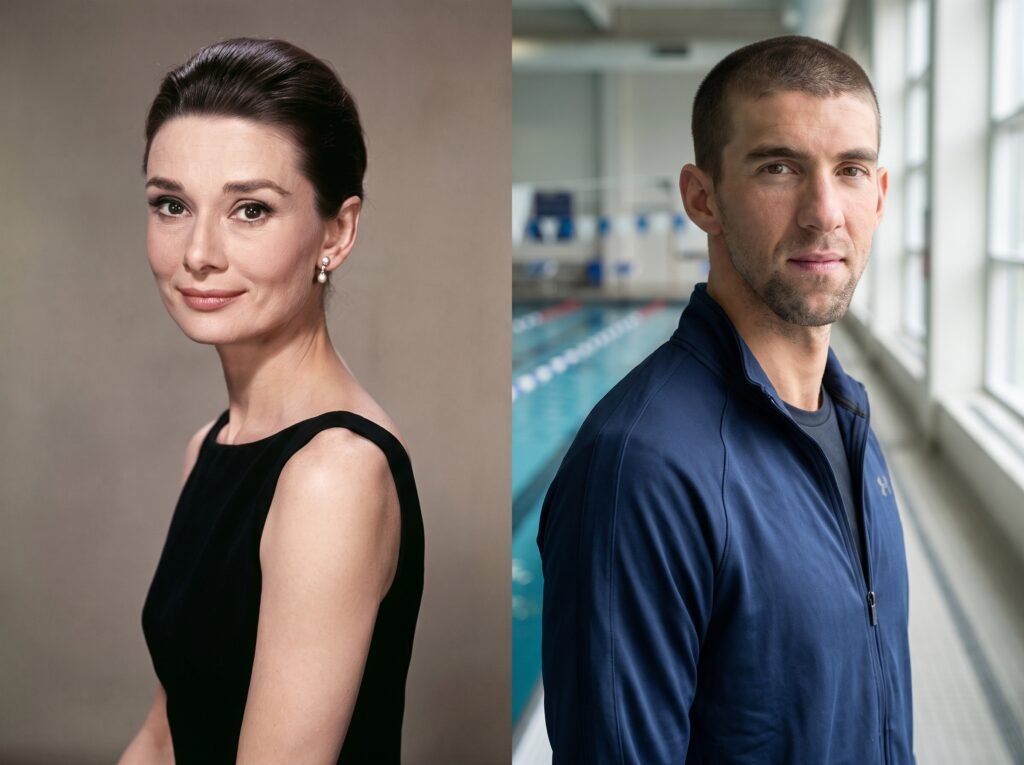
Audrey Hepburn and Michael Phelps belong to different chapters of popular culture. One became a celebrated screen actress whose image remains closely associated with elegance. The other built an extraordinary swimming career that made Olympic history. Seeing their names together naturally raises a question: is there a personal connection, or are people comparing two famous lives?
Table of Contents
The answer needs care. The authoritative biographical and institutional sources reviewed for this article do not establish a family relationship, friendship, or professional partnership between them. Their names can be compared meaningfully, but a comparison should not be mistaken for evidence that their lives were directly connected.
What makes the pairing interesting is the opportunity to look beyond fame. Their stories open up questions about achievement, public identity, responsibility, and how a person can use recognition to benefit others. Those themes offer a more useful starting point than an invented celebrity connection.
This guide explains the basic facts, explores seven dimensions of their legacies, and addresses common questions. It also separates documented information from interpretation, so you can enjoy the comparison without confusing an appealing story with an established historical fact.
Audrey Hepburn and Michael Phelps: Discover What Really Connects These Two Icons
There is no established direct connection in the sources examined here. Hepburn’s documented career belongs to film, fashion, and humanitarian advocacy. Phelps’s public record centres on competitive swimming and his later work around water safety and mental wellness. The connection developed in this article is therefore thematic: it compares the ways their achievements and public roles can be understood.
That distinction matters because putting two famous names in a headline can imply more than the evidence supports. A reader might expect a shared family tree, an encounter, or an unusual collaboration. Without a reliable record of such a link, an article should answer that expectation immediately rather than keeping the reader waiting for a revelation that never arrives.
Their Timelines Help Explain the Difference
Hepburn was born on 4 May 1929 and died on 20 January 1993. UNICEF records her birthplace as Brussels, Belgium, and documents her service as a Goodwill Ambassador from 1988 to 1993. These dates place her best-known public work firmly in an earlier generation. UNICEF’s Audrey Hepburn profile
Phelps was born on 30 June 1985 and made his Olympic debut at Sydney 2000. He was seven years old when Hepburn died, several years before his first Olympic appearance. Their lifetimes briefly overlapped, but their internationally recognised careers did not. U.S. Olympic & Paralympic Museum’s Michael Phelps profile
These dates do not prove that an undocumented encounter could never have occurred. They do explain why the suggestion of a shared adult professional career would be misleading. A responsible account stays within what the records establish.
A Comparison Does Not Require a Hidden Relationship
It is perfectly reasonable to compare people who never worked together. A musician and a scientist can reveal different approaches to practice. An actor and an athlete can help us think about public expectations. The value lies in the question being explored, rather than in pretending that the subjects shared a personal history.
For Hepburn and Phelps, the most productive question is how exceptional achievement becomes a lasting public legacy. Their occupations give us two contrasting examples. Their work outside those occupations adds another layer, allowing the discussion to move from recognition towards responsibility.
1. Their Careers Show Different Forms of Exceptional Achievement
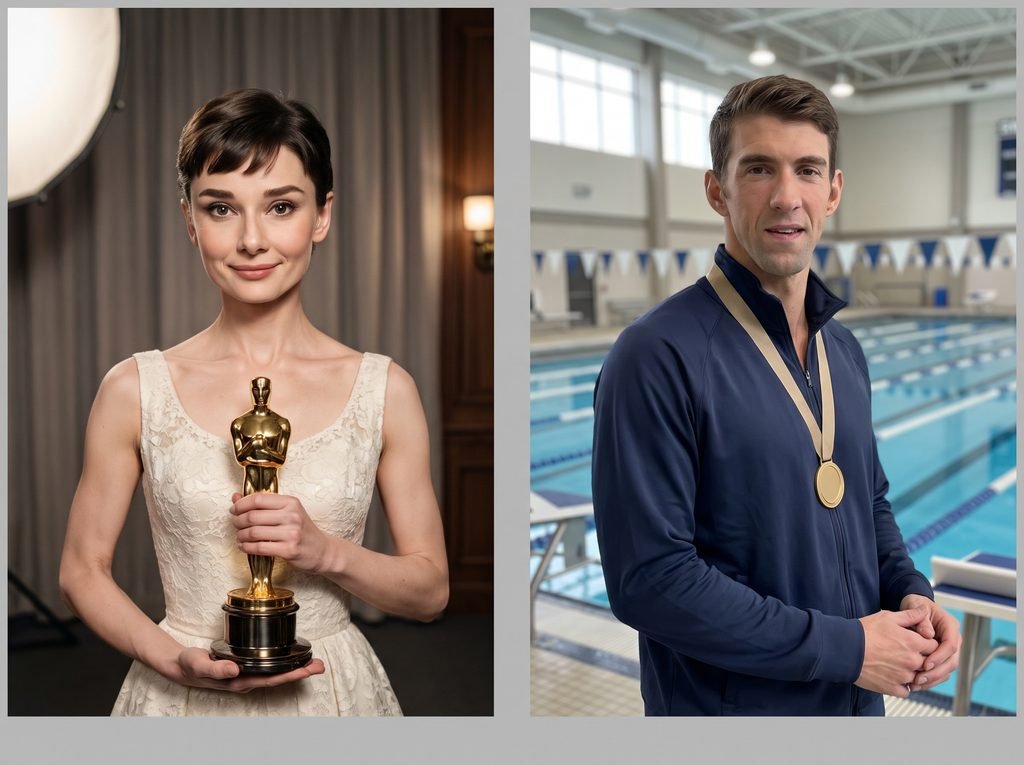
Any useful comparison begins by recognising the distinct demands of the two fields. Acting depends on interpretation, collaboration, and the ability to communicate a character’s inner life. Swimming depends on speed, technique, tactical choices, and performance under precisely measured conditions. Both require skill, but their results cannot be assessed through the same system.
A film performance may remain meaningful because viewers continue to discover something in it. A swimming performance has an official time and finishing position, yet its emotional force also depends on the circumstances of the race. One field leaves room for competing artistic judgments; the other produces a result that a timing system can settle.
Audrey Hepburn’s Oscar-Winning Breakthrough
Hepburn won the Academy Award for Best Actress for Roman Holiday at the 1954 ceremony, which honoured films released in 1953. Keeping the release year and award year separate avoids a common source of confusion. The Academy’s record identifies both the film and her winning category. The 1954 Academy Awards
An acting award offers a useful historical reference point, but it is only an entry into a performance. When watching an acclaimed actor, it helps to notice how a scene changes through pauses, reactions, and shifts in tone. These details are easy to overlook if attention stays entirely on the star’s clothes or appearance.
The pleasure of revisiting a celebrated performance is that a viewer can assess it independently. An award explains how an institution recognised the work at a particular moment. Watching the film allows a new audience to decide what still feels moving, funny, or convincing.
Michael Phelps’s Olympic Record
Phelps earned 28 Olympic medals: 23 gold, three silver, and two bronze. The gold count is not the same as the total medal count. His eight gold medals at Beijing 2008 are another distinct achievement, referring to one edition of the Games rather than his complete career. Olympics.com’s guide to Phelps’s medals
These numbers give readers a clear sense of scale. They also invite a deeper question: what does repeated success demand when every event begins again from zero? Earlier victories do not remove the need to execute the next start, turn, or finish. Each race creates a new test under the rules of that event.
The distinction between career totals and individual performances is useful beyond sport. A long record demonstrates sustained achievement. A particular performance reveals how that achievement happened on one occasion. Understanding both gives a fuller picture than repeating a large number without context.
Why Their Awards Cannot Be Ranked Against Each Other
An Oscar and an Olympic gold medal recognise different activities through different processes. Counting them together would create a false impression of objectivity. There is no meaningful conversion rate between artistic recognition and finishing first in a sporting event.
Instead, the comparison becomes more revealing when it asks what each achievement represents. Hepburn’s award points towards the reception of a screen performance. Phelps’s medals record outcomes in elite competition. Appreciating those differences allows both accomplishments to retain their particular meaning.
2. Their Work Encourages Us to Look Beyond the Finished Performance
Public achievement often appears compressed into a brief moment. A viewer remembers a scene, a photograph, or a swimmer touching the wall. The preparation behind that moment is less visible. That gap between what an audience sees and what a task requires is one of the most useful themes in this comparison.
This is an interpretation of performance, not a claim that Hepburn and Phelps followed identical routines. Their working environments were fundamentally different. Still, considering the practical demands of film and swimming helps explain why apparent ease should not be confused with an absence of effort.
The Craft Behind Screen Presence
Film acting takes place within a network of technical requirements. A performer must work with camera position, lighting, continuity, dialogue, and the timing of other actors. A moment that feels spontaneous on screen may have to remain convincing across several takes and different camera angles.
For readers interested in Hepburn, this offers a rewarding alternative to looking only at publicity portraits. Try watching how a performer listens while someone else speaks. Notice whether a reaction begins before the next line. Observe how posture or stillness changes the mood of a scene without an explicit explanation.
These are questions a viewer can bring to any film. They help turn admiration into attention. Instead of simply accepting that someone had charisma, the viewer begins to examine how a performance produces that impression within the finished work.
The Technical Demands Behind a Swimming Race
A swimming race also contains details that casual viewers may miss. The start, underwater phase, stroke rhythm, turns, and finish all contribute to the result. Different events place different demands on pacing, and a relay adds the coordination required between team members.
This makes a race more than a test of who can try hardest in the final seconds. It is a sequence of movements performed within a competitive situation. Spectators can watch the changing gap between swimmers, the rhythm approaching a turn, and the final approach to the wall.
When revisiting Phelps’s races, paying attention to the entire event makes the result more interesting. The medal becomes the conclusion of a performance that has structure, pressure, and technical detail. That is a richer experience than watching only the celebration afterwards.
A Practical Lesson About Learning
For an ordinary reader, the useful lesson is to make practice more specific. Someone improving their writing might work on clearer openings. A beginner learning an instrument might focus on a difficult transition. A person developing presentation skills might practise speaking at a steady pace.
The goal is not to borrow an imagined celebrity routine. It is to identify the component of your own task that needs attention. Famous outcomes can create motivation, but progress becomes more manageable when the next action is concrete, realistic, and suited to your circumstances.
3. Their Public Images Reveal How Fame Simplifies a Person
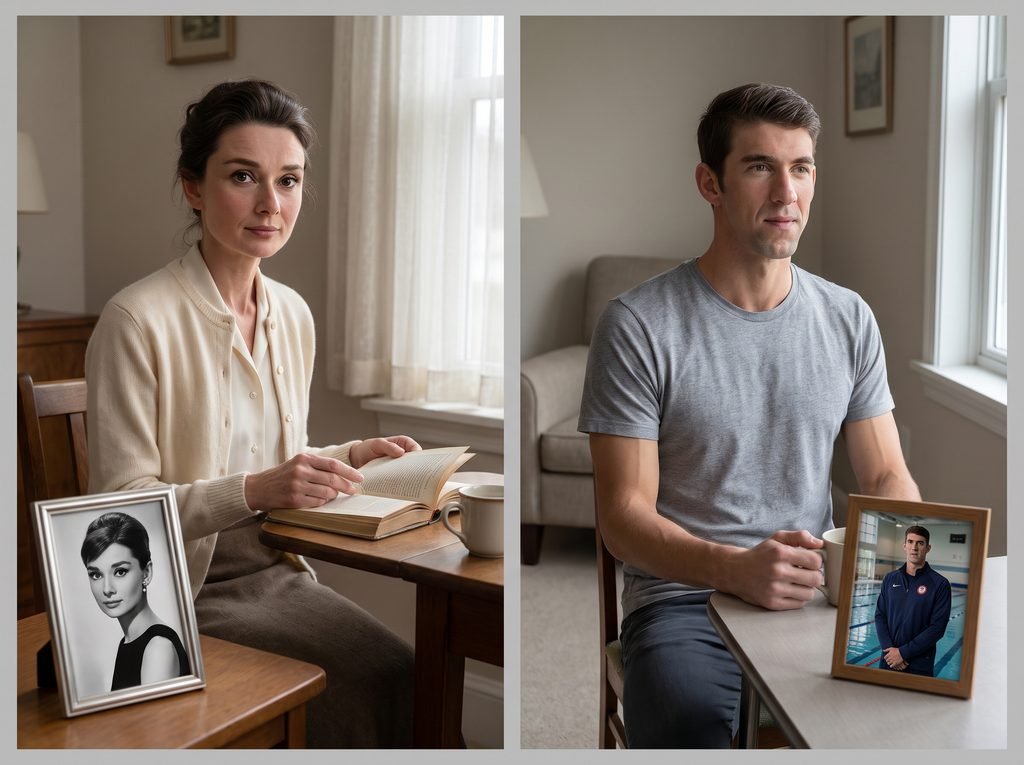
A public image is necessarily incomplete. Most people encounter a celebrity through a small selection of photographs, performances, headlines, and interviews. Those fragments can become so familiar that they start to feel like the whole person, even though they represent only a limited portion of a life.
Audrey Hepburn and Michael Phelps illustrate this in different ways. Hepburn is readily associated with elegant screen imagery. Phelps is readily associated with Olympic victory. Both associations have a factual basis, but neither provides a complete understanding of the individual or the work behind the image.
Hepburn’s Fashion Image Has a Documented History
The association between Hepburn, Hubert de Givenchy, and Breakfast at Tiffany’s is supported by material records. Christie’s describes a black Italian satin evening gown designed by Givenchy for Hepburn as Holly Golightly. That object offers a concrete route into the relationship between costume, character, and public memory. Christie’s record of the Givenchy gown
Clothing can make a screen image immediately recognisable. A silhouette, colour, or accessory may remain familiar even to people who have never watched the film. Yet the familiarity of a costume should encourage further curiosity rather than replace it. The still image cannot show an entire performance or explain a complete life.
A thoughtful appreciation of style can therefore ask how costume serves a scene, how an image has circulated, and what gets left out when a person becomes a visual reference. These questions preserve the appeal of the image while making room for a broader understanding.
Phelps’s Medal Image Also Leaves Things Out
The image of a champion on a podium communicates an outcome with remarkable efficiency. It shows that someone succeeded. It does not show every decision, relationship, difficult period, or ordinary day that exists outside the competition.
Phelps has publicly discussed depression and his experiences after the Olympics. Reporting by Olympics.com gives a basis for discussing those disclosures, rather than speculating about his private health. His own openness complicates the assumption that extraordinary achievement automatically produces emotional wellbeing. Olympics.com on Phelps’s discussion of post-Olympic depression
Readers do not need to know every private detail to recognise that a victory photograph has limits. A person can have a remarkable professional record and still face difficulties beyond what the audience sees. Recognising that complexity makes admiration more humane.
Appreciation Without Unrealistic Comparison
Celebrity imagery can encourage people to judge themselves against a carefully selected moment. A posed portrait or a winning performance becomes an unreasonable standard for an ordinary day. The comparison is unequal before it even begins.
A better approach is to appreciate the work while keeping your own context in view. You can enjoy Hepburn’s style without treating a body type as a requirement. You can admire Phelps’s performances without deciding that exercise only matters when it produces exceptional results. Inspiration is more useful when it leaves room for different bodies, resources, abilities, and goals.
4. Their Charitable Work Broadens the Meaning of Legacy

A public career can create attention that extends beyond the original achievement. The important question is what happens to that attention. Does it remain focused entirely on the celebrity, or does it help audiences understand a need, support an organisation, or participate in something useful?
Hepburn’s humanitarian record and the Michael Phelps Foundation provide documented examples of work beyond entertainment and competition. They operated through different structures and addressed different needs. Their significance becomes clearer when those differences are respected instead of being flattened into a vague statement that both helped people.
Hepburn’s Work With UNICEF
UNICEF describes Hepburn’s visits to emergency operations in Ethiopia and to projects involving vaccination, drinking water, education, and nutrition in other countries. It also records her speeches, interviews, and testimony before the United States Congress. These were identifiable forms of advocacy, with specific issues and audiences. UNICEF’s account of Hepburn’s humanitarian work
The wider lesson is about directing attention. A familiar public figure can make a subject more visible, but the subject should remain the people and programmes involved. Effective coverage of humanitarian work explains the needs being addressed and recognises the expertise of those doing the daily work.
This also changes how readers can assess a charitable legacy. Instead of relying only on flattering descriptions, look for documented activities, organisational records, and a clear account of the purpose. Specifics make the story more informative and more respectful of everyone involved.
The Michael Phelps Foundation’s Areas of Work
The Michael Phelps Foundation describes its mission through water safety, mental wellness, and healthy living education. Its IM Program includes swimming instruction, goal setting, and confidence building, with delivery through partnerships that include Boys & Girls Clubs of America and Special Olympics. Michael Phelps Foundation
This gives the discussion a practical focus. A sporting reputation can draw attention to access: who gets the opportunity to learn, who feels welcome, and what support is available? The relevance of an athlete’s platform is not limited to encouraging future champions. It can also help make useful skills and experiences more accessible.
Readers evaluating any celebrity foundation should take a similar approach. Start with the organisation’s stated programmes, then look for information about delivery and results. A recognisable founder may attract interest, but understanding the work requires more than recognising the name.
Why Different Contributions Should Remain Distinct
It would be misleading to suggest that these activities form one shared campaign. Hepburn’s UNICEF work and Phelps’s foundation are separate parts of separate lives. Their common ground lies in the broader idea of using public recognition to draw attention to needs beyond one’s original profession.
That idea does not require everyone to become a public advocate. A reader might apply it on a smaller scale by sharing reliable information, contributing a relevant skill, or learning about a local organisation. The meaningful step is to connect interest with a specific action rather than leaving it as general admiration.
5. Their Stories Invite a More Careful View of Strength

Celebrity profiles often use strength as a simple label. A person overcame difficulty, achieved something exceptional, and became an inspiration. Such accounts can be emotionally appealing, but they can also make complicated lives sound like straightforward demonstrations of willpower.
A more careful approach recognises that people respond to different circumstances with different resources. Achievement does not erase difficulty, and difficulty does not have to produce a celebrated outcome to deserve compassion. Those principles make this comparison more useful than a conventional success story.
Compassion Is More Than an Attractive Trait
When discussing humanitarian work, compassion becomes meaningful through attention and action. The question is not merely whether a famous person seemed kind. It is whether the public record shows an effort to understand a need and communicate it responsibly.
For readers, this changes the standard of inspiration. A compassionate response might involve listening carefully, avoiding assumptions, or learning what support is actually useful. These actions are less dramatic than a grand gesture, but they help keep the needs of others at the centre of the discussion.
This perspective also resists turning hardship into decoration for a celebrity narrative. People affected by hunger, displacement, or exclusion are individuals with their own lives. They should not appear only as evidence of someone else’s goodness.
Openness Can Challenge Expectations of Success
Public discussion of emotional difficulty can challenge the expectation that successful people should always appear confident. It creates space for a more realistic understanding of achievement. A career milestone is an event; wellbeing is a broader and more complex part of life.
The lesson for readers is not to treat a celebrity’s experience as a diagnosis or a personal treatment guide. It is to avoid assuming that visible success tells you how someone feels. Listening without making that assumption can improve everyday conversations with friends, colleagues, and family members.
A person does not need an impressive explanation for needing support. Equally, an inspiring account should not imply that distress can always be overcome by working harder. A humane view of strength includes acknowledging limits and allowing people to speak honestly.
Different Lives Should Not Be Reduced to One Formula
The phrase “overcoming adversity” can obscure more than it explains when it is used without detail. A childhood shaped by historical events, the pressures of public life, and an individual’s health experiences are not interchangeable. Each requires its own context.
The strongest comparison therefore preserves difference. It asks what readers can thoughtfully learn while resisting the temptation to turn both lives into the same motivational script. Respecting complexity does not weaken an inspiring story. It gives the inspiration a more credible foundation.
6. Their Legacies Show Why Context Matters Online

Search results place unrelated subjects beside one another all the time. A headline may invite comparison, but it may also create an impression of a relationship that the article never demonstrates. Readers benefit from pausing to ask what kind of connection is actually being claimed.
For Audrey Hepburn and Michael Phelps, that question should come before any dramatic explanation. Is a source describing a historical encounter, a shared cause, a resemblance, or simply a comparison? These are different claims, and they require different kinds of evidence.
Recognising the Difference Between Evidence and Repetition
A claim appearing on several websites is not automatically independently verified. The pages may repeat the same unsupported statement. Useful confirmation comes from evidence appropriate to the claim, such as an institutional record, an attributable interview, or a documented event.
Readers can apply a simple test: does the source explain how it knows? A medal record can support a sporting total. An award archive can identify a winning performance. Neither can establish a private friendship merely because both names appear elsewhere on the internet.
This is especially important with celebrity pairings, where a surprising headline can attract attention without providing a meaningful answer. A trustworthy article should make the limits of its evidence easy to understand.
Health Claims Require Particular Care
Physical resemblance is not a reliable basis for claiming that celebrities share a medical condition. Height, limb proportions, or a slender appearance cannot establish a diagnosis. The Marfan Foundation explains that diagnosis involves medical assessment and may involve several examinations and tests. Marfan Foundation’s diagnosis guidance
Accordingly, this article does not claim that Hepburn and Phelps shared Marfan syndrome or another medical diagnosis. A suggestion based on photographs or an unsourced list is not enough. General medical information cannot fill a gap in an individual’s documented history.
The same care should apply when writing about any public figure. There is a meaningful difference between describing what someone has publicly disclosed and assigning a condition based on appearance. Keeping that boundary clear protects accuracy and avoids encouraging readers to assess themselves through celebrity comparisons.
Quotations and Images Also Need Context
An attractive quotation printed beside a portrait is not proof that the person said it. Before sharing a quote, look for its original interview, speech, book, or another traceable source. If the origin cannot be established, paraphrasing your own takeaway is safer than presenting it as someone else’s words.
Images can create similar confusion. A collage placing two people together should not be treated as evidence that they met. Captions should distinguish a comparison graphic from an actual photograph of a shared event. Good presentation helps readers understand the evidence instead of accidentally inventing a new claim.
7. Their Work Offers Better Starting Points Than Celebrity Myths

The most satisfying way to explore famous lives is to engage with the work and records that made them significant. A biographical summary is useful, but it should open a door. Films, race footage, institutional archives, and programme descriptions allow readers to move beyond a handful of familiar claims.
This approach also makes the comparison more personal in a useful sense. Different readers will notice different things. One may be drawn to performance, another to sporting history, and another to public service. There is no need to force every interest into the same interpretation.
Explore More Than One Side of Hepburn’s Film Career
Hepburn’s filmography includes Sabrina, Funny Face, The Nun’s Story, Charade, My Fair Lady, and Wait Until Dark, alongside Roman Holiday and Breakfast at Tiffany’s. The British Film Institute’s overview provides an introduction to that range. BFI’s guide to ten Audrey Hepburn films
Rather than treating every title as another example of the same image, compare the demands of different genres. A musical, a thriller, and a romantic comedy ask different things of a performer and an audience. Notice what changes in pacing, physical expression, and the emotional purpose of a scene.
You can also separate your response to the performance from your response to the film as a whole. Admiring an actor does not require liking every creative choice or ignoring dated elements. Thoughtful appreciation leaves room for both enjoyment and criticism.
Watch Sporting Achievement With a Specific Question
When revisiting a Phelps race, choose one element to follow. You might track the order of swimmers through the turns or observe how a relay changes as each team member enters. Watching with a question makes the event easier to understand than trying to notice every technical detail at once.
It also encourages respect for the competitors and teammates around the best-known name. A race is a competitive event involving several athletes, and a relay result depends on a team. Celebrity-focused coverage can make that wider setting disappear even though it is essential to what happened.
The same viewing habit works in other sports. Instead of asking only who won, ask what decisions and circumstances made the event memorable. That turns a highlights clip into an opportunity to understand performance more deeply.
Turn Inspiration Into Something Achievable
After exploring their work, choose one action that fits your own interests. It might be learning more about film, following a sport with greater attention, or reading about an organisation’s programmes before deciding how to support it. The action should be specific enough that you can actually complete it.
There is no requirement to transform your life because a famous person’s story moved you. A small, considered step is more useful than an ambitious promise you cannot sustain. The value of inspiration lies in what it helps you notice, understand, or do next.
Frequently Asked Questions About Audrey Hepburn and Michael Phelps
Are Audrey Hepburn and Michael Phelps Related?
The reliable sources reviewed for this article do not establish a family relationship. Their names appearing together in a headline does not demonstrate shared ancestry. A claim of a family connection would need genealogical evidence or another dependable record, rather than a general comparison of their careers.
Did Audrey Hepburn and Michael Phelps Ever Work Together?
No professional collaboration is established in the sources reviewed here. Their timelines also place their recognised careers in different periods. It is more accurate to describe this article as a comparison of two public figures than as the story of a partnership.
Were They Both American?
Phelps is an American swimmer. Hepburn was a British actress born in Belgium whose career included major Hollywood films. Working in American cinema does not by itself make a performer American. Keeping nationality, birthplace, and professional setting distinct prevents an easy but misleading description. BFI’s Hepburn overview; U.S. Olympic & Paralympic Museum
What Do They Have in Common?
They can be compared through outstanding achievement, widely recognised public images, and work beyond their original professions. Those are interpretive parallels, not proof of a personal bond. The comparison is strongest when it explains both the similarities and the differences in how their public lives developed.
Why Should Readers Be Careful With Celebrity Comparisons?
A comparison can quietly become an unsupported factual claim if its wording is careless. Saying that two people illustrate a similar theme is different from saying they knew one another or shared a diagnosis. Clear sourcing and precise language help readers enjoy an interesting article without leaving with a false impression.
What Their Legacies Invite You to Do Next
Audrey Hepburn and Michael Phelps offer two different routes into a discussion of lasting influence. Their achievements belong to distinct fields, and the available evidence does not establish a direct personal connection. What makes them worth considering together is the opportunity to think carefully about skill, public identity, and the uses of recognition.
You can appreciate the memorable image while looking for the fuller story. You can respect a record without reducing a person to a total. You can admire charitable work while asking concrete questions about its purpose. These habits make celebrity coverage more informative and make the inspiration it offers more practical.
Take the next step today: choose one film, one race, or one official programme page linked in this guide and explore it more closely. Then leave a comment sharing which aspect interested you most—performance, perseverance, or service—and explain why. If this article helped you separate facts from assumptions, share it with someone who enjoys thoughtful stories about remarkable people.