Safra Catz and John Stankey: 7 Essential Business Insights
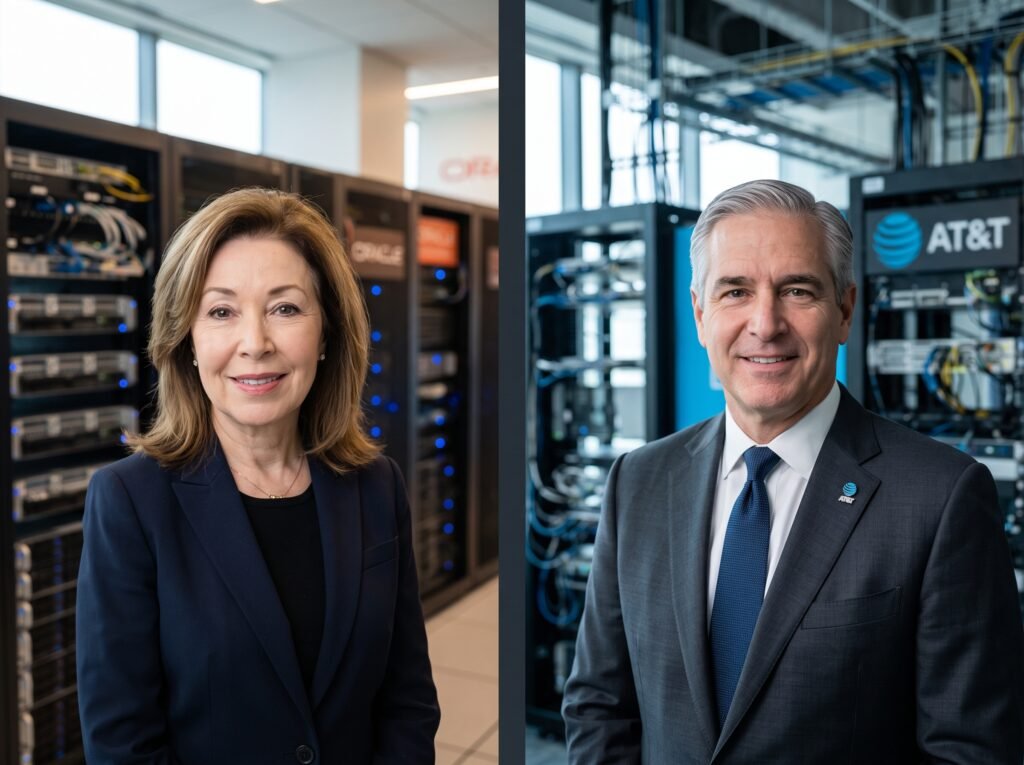
Safra Catz and John Stankey are business leaders associated with Oracle and AT&T, respectively. As of September 23, 2026, Catz is executive vice chair of Oracle’s board, while Stankey is AT&T’s chairman and chief executive officer. Their companies have documented cloud and communications agreements. Those agreements provide a clear business connection, but they do not establish a personal partnership between the two executives.
Table of Contents
If you are searching for their backgrounds, the most useful starting point is what each person does and how the companies connect. Oracle supplies business software, databases, and cloud services. AT&T supplies communications services, including wireless and fiber internet. These areas come together when businesses need both working software and reliable connections.
One update matters before going further: calling Catz Oracle’s current CEO is outdated. Her role changed in September 2025. The current titles are supported by Oracle’s executive biography and AT&T’s board biography.
The seven insights below explain their careers, their different responsibilities, and the evidence behind the Oracle–AT&T relationship.
1. Safra Catz and John Stankey Hold Different Leadership Roles

Company titles help explain who runs daily operations and who helps guide the wider business. They are especially important here because the two executives no longer hold equivalent positions.
| Point of comparison | Safra Catz | John Stankey |
|---|---|---|
| Main company association | Oracle | AT&T |
| Current role | Executive vice chair of the board | Chairman and chief executive officer |
| Earlier responsibilities | CEO, president, and chief financial officer | Operations, strategy, technology, and media leadership |
| Main business context | Enterprise software and cloud computing | Telecommunications and connectivity |
What changed at Oracle in September 2025?
On September 22, 2025, Oracle announced that Clay Magouyrk and Mike Sicilia were becoming CEOs. Catz, who had served as CEO since 2014, moved into the executive vice chair role. The company said she would continue helping guide Oracle’s direction with Larry Ellison. This was a change of responsibility within Oracle, rather than an announcement that she was leaving the company. See Oracle’s leadership transition announcement.
For beginners, the distinction is straightforward. A CEO leads management and business execution. A board helps oversee the company and its direction. An executive vice chair can remain actively involved, but the title should not be treated as another name for CEO. The precise duties depend on the company.
What is John Stankey’s current position?
AT&T identifies Stankey as chairman, CEO, and president. He became CEO and president in July 2020 and added the chairman role in February 2025, according to its board biography.
This gives the comparison an important limit. You can compare their experience and business decisions, but describing them as two current CEOs would mislead readers. Always match a title to the date of the event being discussed.
2. Safra Catz’s Career Connects Finance With Technology Leadership
Catz’s background shows that a senior technology career does not have to begin in software engineering. Before Oracle, she worked at investment bank Donaldson, Lufkin & Jenrette, where her positions included managing director in investment banking. Oracle’s biography also records her previous roles as president and chief financial officer.
She joined Oracle in 1999, a date recorded in Oracle’s historical speaker biography. That page is useful for career history, although its old CEO title should not be used as her current position.
Why a finance background matters in a software company
A large software company needs much more than a good product. It must decide how to fund development, support customers, price services, and plan spending. Financial knowledge helps leaders ask whether an idea can become a lasting business.
Consider a hypothetical software provider building a new data center. Engineers may know which equipment is needed. Sales teams may expect customer demand. Finance teams still need to work out how much the project costs, when customers will pay, and what happens if demand grows more slowly than expected.
This example illustrates why financial experience can matter in technology leadership. It is not a claim about a particular decision made by Catz.
What her background does and does not tell us
Her documented career supports a description of broad financial and executive experience. It does not, by itself, prove every claim about her personality or management style.
Labels such as “ruthless,” “visionary,” or “the person behind every deal” need separate evidence. A useful business profile explains actual responsibilities before making judgments about leadership. It also remembers that company results come from many teams, alongside customer demand, competition, and wider market conditions.
For readers exploring careers, her path offers a practical lesson: finance, operations, and commercial knowledge can be relevant routes into technology management. Coding is one route into the industry, but it is not the only one.
3. John Stankey’s Career Spans Several Parts of AT&T
Stankey began his career with the company in 1985. Before becoming CEO, he held roles covering technology, business services, operations, strategy, and entertainment. His earlier positions included chief information officer, chief technology officer, and CEO of WarnerMedia. These roles are listed in AT&T’s official account of his career.
That background helps explain why his work involves more than mobile phone plans. A communications business has to connect engineering decisions with customer service, pricing, construction, and long-term spending.
Why telecommunications leadership is complex
A network must work while the company upgrades it. Customers expect calls, messages, internet access, and business connections to remain available. At the same time, the operator must decide where to expand and which technology to install.
Imagine a hypothetical town where a provider is considering new fiber connections. Demand matters, but so do installation costs, construction access, existing equipment, and support requirements. A promising market may still take time to serve.
This is why experience across different departments can be useful. A decision that looks simple in a sales presentation may create difficult work for engineers, installers, or customer support teams.
Why his media experience needs historical context
Stankey’s previous WarnerMedia leadership belongs in his career history. It should not be used as a shortcut for describing AT&T’s current priorities.
In its September 8, 2026 shareholder update, AT&T emphasized its investment strategy around fiber and 5G. Readers can review that focus in AT&T’s strategy update ahead of the Goldman Sachs conference.
The broader lesson is to separate an executive’s past assignments from the company’s present direction. Both are useful, but they answer different questions.
4. Oracle and AT&T Have a Verified Business Relationship
The strongest documented connection in this comparison is between the companies. Oracle and AT&T have announced work together involving cloud services and communications technology.
That is more specific than saying the executives are connected because both are well known. It also gives readers something they can check: dated announcements describing the services involved.
The five-year cloud agreement announced in 2022
On August 10, 2022, Oracle announced a five-year extension of its cloud agreement with AT&T. The announcement covered Oracle Cloud Infrastructure and business applications, including enterprise resource planning and customer experience software. It described support for AT&T’s technology modernization and data center consolidation. The details appear in Oracle’s announcement distributed through PR Newswire.
In plain English, this involved technology AT&T could use to run parts of its business. Enterprise resource planning, often shortened to ERP, brings together work such as finance and purchasing. Customer experience software helps businesses manage interactions with customers.
The date matters. A five-year deal announced in 2022 is a historical agreement, not proof that every service or contract term remains unchanged today. The public announcement also does not provide a basis for claiming that Catz and Stankey personally negotiated every detail.
The communications integration announced in 2024
On August 12, 2024, Oracle announced that it was incorporating AT&T Internet of Things connectivity and network APIs into its Enterprise Communications Platform. It described availability across Oracle Cloud Infrastructure regions in the United States. See Oracle’s AT&T connectivity announcement.
The Internet of Things, or IoT, refers to connected devices such as sensors and equipment that exchange data. An API is a defined way for software systems to communicate.
Together, those ideas explain the practical purpose: applications can use network connections to receive information from devices and support business processes.
What these announcements establish
They establish a corporate relationship involving specific technology services. They do not establish a privately owned venture between the executives, explain their personal relationship, or reveal every internal decision.
Keeping that boundary clear makes the article more useful. Readers get a real connection supported by documents, without speculation added around it.
5. Cloud Software and Communications Solve Different Problems

Oracle and AT&T operate in connected parts of the technology economy, but their main business functions are different. Understanding that difference makes the comparison easier to follow.
Oracle’s role in the agreements discussed here centers on software, databases, and computing resources. AT&T appears both as a customer using that technology and as a provider of connectivity for applications.
A simple example of how the services fit together
Imagine a hypothetical delivery business with drivers, warehouses, and an online booking system. Its software records orders and calculates schedules. Its database stores delivery details. Network connections allow staff and devices to send updates.
If the application fails, employees may be unable to process orders even when their internet connection works. If the network connection fails, a driver may be unable to send an update even though the application is running normally.
This example shows why businesses may need both kinds of provider. It does not describe a named Oracle or AT&T customer or promise any particular result.
A documented example inside AT&T
Oracle’s published AT&T customer story describes the use of cloud ERP and enterprise performance management, or EPM, for finance and planning. It explains that AT&T sought to reduce the complexity of older systems and make information easier to use across teams. Read Oracle’s case study on AT&T’s finance systems.
EPM software supports tasks such as planning, forecasting, and comparing results with budgets. While ERP helps record business activity, EPM helps teams assess that activity and plan ahead.
The case study is useful evidence of the systems involved. Because Oracle publishes it, reported benefits should be understood as a supplier’s customer account, rather than an independent test. The page also includes historical project plans, so those plans should not automatically be described as completed work.
Why this matters outside the United States
Readers in the UK and other countries can use this comparison to understand how business technology fits together. However, a US availability statement does not establish local service availability elsewhere.
For a real purchase, check the product’s local coverage, support, and contract terms. An international company name alone does not mean every offering is available in every market.
6. Comparing Their Leadership Requires More Than a Headline
It is tempting to ask which executive is more successful. That question needs a clear definition before it can produce a useful answer.
Success could mean company growth, customer satisfaction, operating reliability, employee development, or the delivery of a long-term project. Different measures can produce different conclusions.
Compare responsibilities and time periods
First, identify what each person was responsible for during the period being discussed. Comparing Stankey’s current CEO role with Catz’s current board role requires different expectations than comparing their earlier years as CEOs.
Second, use matching dates. A company’s recent performance cannot fairly be compared with another company’s figures from several years earlier without explaining the difference.
Third, account for the business model. Building network infrastructure and selling enterprise software create different costs, risks, and timelines. A single revenue figure cannot explain all of those differences.
Separate plans from results
Corporate announcements often describe intended benefits. A plan to simplify systems is not proof that the entire project has finished. A forecast for growth is not a recorded result.
A useful reading habit is to notice the verbs. “Plans,” “expects,” and “aims” describe intentions or forecasts. “Completed” and “reported” describe events or results, though the supporting details still matter.
This distinction helps readers assess claims about both executives without turning an ordinary business profile into either praise or criticism unsupported by evidence.
Avoid using personal wealth as a performance score
Net worth, salary, and total compensation mean different things. Salary is one part of pay. Total compensation may include bonuses and equity awards. Net worth is an estimate of assets minus liabilities.
An article that swaps these terms can create a false comparison. This guide does not assign either executive an unverified wealth figure. For understanding their professional roles, documented responsibilities are more useful than an unsourced ranking.
7. Their Careers Offer Practical Lessons About Business Research
The comparison of Safra Catz and John Stankey is useful beyond their biographies. It shows how to read executive profiles and company announcements more carefully.
Start with the question you actually want answered
If you want to know who someone is, begin with the employer’s executive biography. If you want to understand a partnership, read the announcement describing that agreement. If you want to evaluate results, look for dated financial reports or operational updates.
One source rarely answers every question. A biography is good for titles and career history, but it is not an independent assessment of performance. A press release establishes what a company announced, but it may emphasize benefits and leave out commercial details.
Keep a short record of dates and evidence
For a school assignment, business report, or blog post, record the claim, the source, and the relevant date. This simple habit prevents a common mistake: presenting a historically correct statement as a current fact.
Catz’s title change is a clear example. An older article can accurately identify her as Oracle CEO at the time it was written. Reusing that title in a new profile without checking it creates an error.
Likewise, an old contract announcement remains useful evidence of a deal. It does not replace a current check of services, availability, or terms.
Draw lessons without inventing personal motives
Their career histories show the value of learning how different parts of a business work. Finance, technology, customer needs, and operations all affect major decisions.
That is a reasonable lesson from the comparison. Claiming to know why either executive made a private decision would require direct evidence. Good business writing makes clear where the documented facts end and interpretation begins.
Frequently Asked Questions
Are Safra Catz and John Stankey founders of their companies?
No. Their recorded careers show that they joined already established businesses: Catz joined Oracle in 1999, and Stankey began his career with the company in 1985. They are associated with executive leadership rather than founding those businesses.
Does a company partnership prove they work together personally?
No. The public agreements establish collaboration between Oracle and AT&T. They do not describe every executive’s direct involvement. Large agreements can involve commercial, technical, legal, and operational teams.
Is Oracle part of AT&T?
No. The sources discussed here describe agreements between separate companies. Buying cloud services or integrating network technology does not, by itself, create common ownership.
Where should readers check for later updates?
Start with Oracle’s executive pages and AT&T’s leadership pages for job titles. Use their newsrooms and investor relations pages for dated announcements. Check both the publication date and the date when any change took effect.
Conclusion: Understand the Roles Before Comparing the Leaders
Safra Catz and John Stankey provide two different views of large-company leadership. Catz’s career includes finance and senior management at Oracle, while Stankey’s spans several parts of AT&T. Their companies connect through documented cloud and communications work.
The most useful comparison keeps three things separate: the executives’ career histories, their current responsibilities, and the agreements between their employers. That approach avoids outdated titles and unsupported claims about personal connections.
Want to understand the relationship more deeply? Open the linked company announcements, choose one agreement, and identify the customer need it was meant to address. Then check a later update before treating the planned benefits as proven results.